


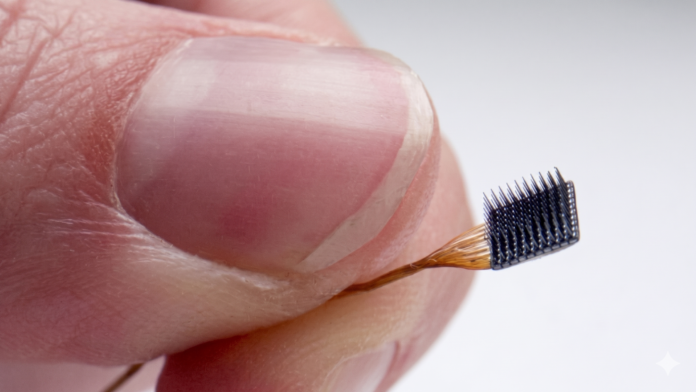
Scientists from Emory University and the Georgia Institute of Technology (Georgia Tech) have developed a Brain-Computer Interface (BCI) that uses artificial intelligence to restore communication abilities to paralyzed patients. The new system translates electrical brain activity into text and speech with 96% accuracy.
The research primarily focuses on patients who are unable to speak due to Amyotrophic Lateral Sclerosis (ALS), spinal cord injuries, or strokes. Surgeons implant ultra-small $3 \times 3$ mm sensors just 1 millimeter deep into the patient’s brain. When a patient attempts to speak, these sensors detect brain signals, and specialized AI algorithms transform them into sentences displayed on a screen. According to the scientists, the system’s accuracy currently ranges between 90% and 96%, allowing patients to compose full messages.
While the technology is based on the concept of “mind-reading,” researchers emphasize the full protection of patient privacy. The device only captures thoughts that the patient intends to communicate and does not read their internal, private monologue.
Dr. Nicholas Au Yong, a neurosurgeon at Emory University, explains that the technology restores independence to individuals who have fully preserved cognitive functions but are physically unable to interact with the world.
Dr. Chethan Pandarinath, an Associate Professor at Georgia Tech, notes that in the future, this technology could function as a universal translator. He states that the system’s concept works identically regardless of whether the language is English, Spanish, or Chinese. While achieving perfect 100% accuracy remains the primary target, current results are already sufficient to radically improve the quality of life for patients.
