


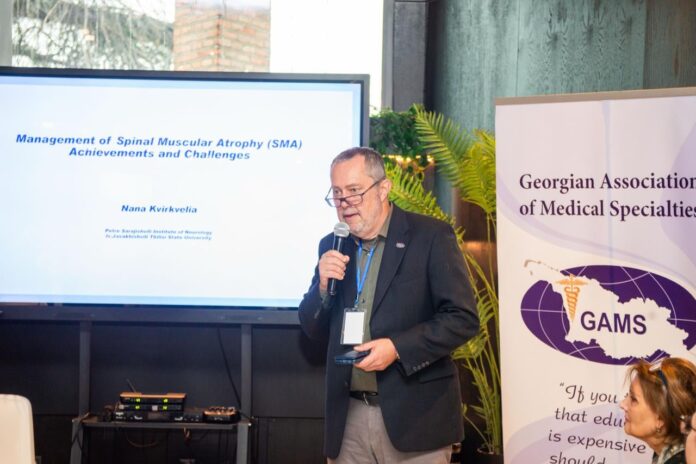
The international conference “Spinal and Spinal Cord Disorders – Challenges” was held on November 15, organized by the Georgian Association of Medical Specialties (GAMS). The meeting clearly showed that scientific innovations today face practical difficulties. The best way to solve these clinical problems is to maximize the refinement of the diagnostic process and tailor treatment strictly to individual needs.
One of the main topics of the conference was how effectively regenerative therapy (methods for restoring damaged tissue) can help patients with Spinal Cord Injury (SCI). Researchers placed a special emphasis on how to help the brain and nerves create new connections so that patients can better move and restore function. They also discussed how to treat chronic pain and spasticity (involuntary muscle stiffness). The management of spinal cord injury in the future will be achieved through a multidisciplinary approach, as modern medicine simultaneously uses: pharmacology, cognitive methods (brain/behavior training), and neuromodulation (electrical or magnetic stimulation).
In other words, the conference showed that the future management of spinal cord injury will happen collaboratively, where brain plasticity, medications, and modern technologies will complement each other.
Despite this progress in therapeutic approaches, evaluating the results of spinal cord injury still remains a complex task, often leading to prognostic uncertainty. This is where the structure-function paradox of SCI manifests: why do radiological data often contradict clinical manifestations? This discrepancy reminds us that clinical decision-making requires an integrated analysis of diverse data to ensure an optimal therapeutic strategy.
Furthermore, special attention during the meeting was paid to spinal strokes in young people—a rare condition whose management is complicated by the scarcity of guidelines and evidence-based data. Clinical cases were also presented, the analysis of which revealed the critical role of rare etiologies in differential diagnosis. Myelitis was also not overlooked; its discussion is now taking place in the context of spectral pathologies, instead of the previously existing monolithic view focused solely on Multiple Sclerosis.
The issue of the growing incidence of neurodegenerative pathologies in Georgia in recent years has given special relevance to this group of diseases. Since the progression of Amyotrophic Lateral Sclerosis (ALS) cannot be halted at this stage, the discussion focused on early diagnosis, the involvement of a multidisciplinary team, and the necessity of palliative care. It was emphasized that maintaining the patient’s quality of life requires the strategic planning of symptomatic management, which includes the integration of respiratory, nutritional, and psychosocial support.
In parallel with many challenges, we cannot deny the significant progress that has been made recently; this advancement is focused on tailoring treatment as much as possible to the patient’s needs and comfort. This was confirmed by Shital Patel’s report, which was dedicated to innovative ways to treat Myasthenia Gravis, specifically the presentation of a Immunovant’s new drug that patients can self-inject at home. The emergence of this medication is based on a Phase III study in which Georgia is also involved, promising the improvement of therapeutic approaches in the near future.
