


Knee osteoarthritis is one of the most common chronic diseases globally, causing pain, mobility limitations, and a decreased quality of life for millions of people. Although physical therapy, anti-inflammatory medications, and intra-articular injections have been considered the mainstay treatments for many years, a significant portion of patients eventually undergo total knee arthroplasty (joint replacement). Against this backdrop, a minimally invasive method — Genicular Artery Embolization (GAE) — is garnering increasing attention.
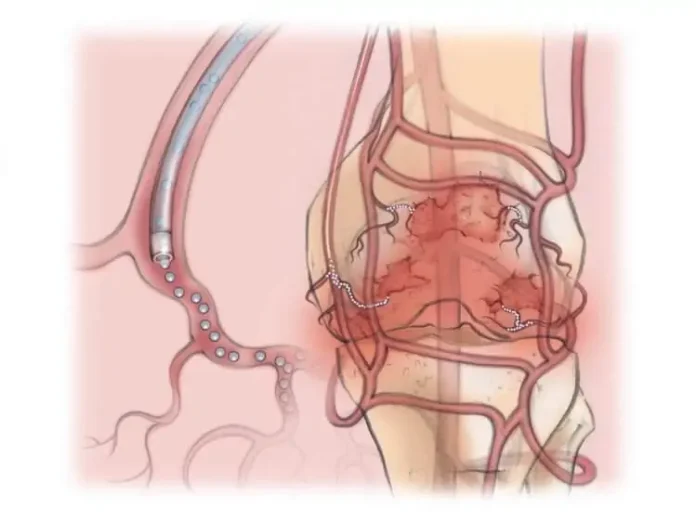
GAE is an interventional radiology procedure in which a specialist uses a catheter to reach the small arteries around the knee and utilizes microparticles to block the pathological blood vessels that contribute to inflammation and pain development. In recent years, it has become clear that cartilage wear is not the sole culprit for pain in osteoarthritis. Synovial inflammation, hypervascularity (the formation of new blood vessels), and the accompanying growth of nerve fibers play a significant role. GAE specifically targets this pathological network.
A systematic review and meta-analysis published in 2026, which encompassed 45 studies and more than 2,200 patients, demonstrated that patients experienced clinically significant reductions in pain and functional limitations following the procedure. The authors concluded that the improvement was frequently sustained in both short-term and one-year follow-ups. Side effects were mostly mild and transient, including temporary skin discoloration and minor hematomas.
Of particular interest was a German study published in 2026, the results of which were presented in the journal Radiology. The study involved 194 patients, 45 of whom underwent the procedure on both knees. All participants had previously received standard treatment for at least three months without obtaining adequate relief. According to the study results, pain intensity on a scale from 0 to 10 decreased from an average of 7 points to 4 points at six weeks, and further dropped to 3 points at 6 and 12 months. Concurrently, functional capabilities and quality-of-life indicators improved significantly.
However, not all studies are equally optimistic. A randomized, sham-controlled trial published in 2026, which evaluated the actual effect of the procedure compared to a placebo, showed that the outcomes are more complex. Although significant improvement was recorded in some patients, the authors also highlighted the substantial role of the placebo effect. Consequently, debates continue today regarding which patients make the best candidates for GAE.
Most specialists agree that the method holds the most promise for patients with mild-to-moderate osteoarthritis who have failed conservative treatment but are not yet willing or able to undergo joint replacement surgery. In cases of severe deformities or “bone-on-bone” osteoarthritis, the outcomes are less predictable.
Despite certain lingering questions, interest in GAE is growing rapidly. The procedure does not require open surgery, the rehabilitation period is short, and the complication rate is low. Because of this, many researchers view it as an intermediate bridge between conservative management and total knee arthroplasty. However, larger-scale, multicenter, and long-term follow-up studies are essential to firmly establish its definitive place in clinical practice.
