


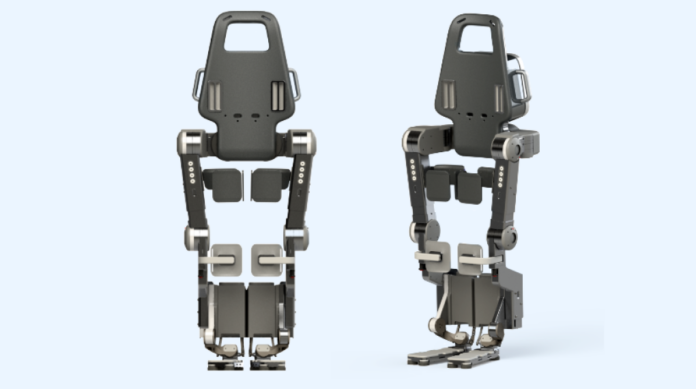
As a result of a car accident in 2014, 16-year-old Jessica Tawil suffered a severe spinal cord injury (T6 paraplegia). For an entire decade, she remained completely paralyzed, relying solely on a wheelchair for mobility. Ten years later, she was able to stand up and take independent steps for the first time, made possible by Atalante, an innovative robotic system from Wandercraft.
An exoskeleton is a robotic device worn on the human body, designed to restore lost mobility or enhance physical capabilities. While early models were viewed merely as mechanical supports, today’s systems are high-tech computers that “collaborate” with the human nervous system.
One of the leaders in this field is the French company Wandercraft, founded in 2012. Their goal was to create the world’s first “self-balancing” exoskeleton that would allow patients to walk without the need for crutches. The company’s flagship product, Atalante, is the direct realization of this mission. It utilizes complex algorithms that enable the robot to shift its center of gravity and maintain balance on any surface, much like a human being.
How Does an Exoskeleton Work?
The Wandercraft Atalante is a cutting-edge, AI-powered exoskeleton that employs a revolutionary approach to the rehabilitation process. Its operating principle is based on several core components.
First and foremost is sensory control. High-precision sensors embedded in the system constantly analyze the body’s micro-movements. Artificial intelligence processes these signals and “translates” them into corresponding robotic movements, ensuring seamless synchronization between the machine and the human.
Another key advantage of this model is autonomous balance. Unlike previous generations of exoskeletons, Atalante maintains balance on its own. This feature is critically important, as it allows the patient to walk in a fully upright position without the need for crutches or other assistive devices.
Furthermore, the technology requires individual customization. In Jessica’s case, the process began with a full body scan and bone density analysis. This was essential to ensure that the robotic suit precisely matched the patient’s anatomical data for maximum efficiency.
Ultimately, clinical data demonstrates that such technology does more than just aid mobility; it significantly improves blood circulation, muscle tone, and cardiovascular function.
Jessica Tawil’s story is a vivid example of how the synthesis of robotics and neuroscience is transforming lives. Today, this technology is already being actively used not only for spinal cord injuries but also in post-stroke rehabilitation.
