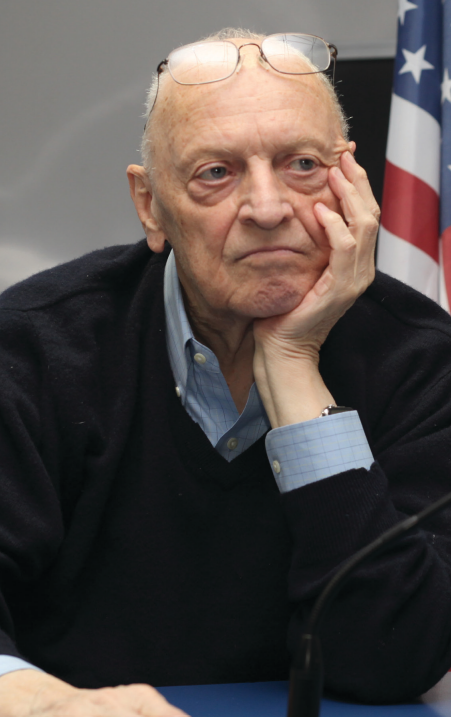
2026/ First edition Ken Walker – The American Doctor Who Gave His Heart to Georgia By Ekaterine Saria
“That Was When I Met Ken Walker…” This is the story of an American doctor who arrived in Georgia almost by chance during the dark 1990s, and then came to love the country so deeply that caring for it became his life’s mission.
“He loved explaining the meaning of dzmakatsi (buddy) to Americans. He always said the word in Georgian, and then would spend a long time explaining that it described a different kind of friendship, one often stronger than family ties. He used to say that only Georgians truly understood this kind of bond, and he was so moved by it that he became a lifelong dzmakatsi to this country and its people.”
I first heard about Ken from my sister. She was part of the group of Georgian doctors personally trained by Ken Walker, who helped lay the foundations for Georgia’s modern emergency medicine system. Later, I heard about him through my son, who graduated from the university Ken created and is now continuing his professional development in Atlanta.
While working on this magazine, what struck me most was the sheer breadth of Ken Walker’s influence. I did not meet a single successful doctor, nurse, public health specialist, or medical manager of that generation whose biography did not contain the same turning point: “That was when I met Ken Walker…”
For some, it was their first scholarship. For others, it was the chance to study in the United States, or professional support at the most difficult moment in their career. For many, Ken Walker became the mentor who convinced them they were capable of doing more.
Ken Walker was always ahead of his time. While many saw knowledge and experience as the doctor’s highest virtues, Ken understood medicine as a profoundly human mission. Even then, he was speaking about empathy, humanism, respect for the patient’s dignity, and the need for warmth, communication, and support.
Today, when we speak about modern emergency medicine in Georgia, American medical programs, international curricula, rehabilitation centers, and hundreds of competitive young doctors, his imprint is visible everywhere.
This story also has a second central figure: Archil Undilashvili, who did not allow Ken Walker’s ideas to remain only memories of the past. He built a coherent system that continues to work and grow. The American program created from Ken’s vision is now one of the most successful medical programs in Georgia; every year, the number of Georgian doctors entering residency programs in the United States increases; and the rehabilitation center and university named after Ken Walker have become real academic and clinical spaces, not merely symbols.
Ken’s greatest achievement, perhaps, is that he nurtured people who would go on to continue his work. Archil Undilashvili is the clearest example of that legacy: a worthy student who became a leader in his own right.
The modern history of Georgian medicine is not only a history of reforms, programs, and international partnerships. It is also a history of people. And within that history, two names stand out: Ken Walker and Archil Undilashvili. One introduced Georgia to a Western vision of medicine. The other turned that vision into a system.
A Man Ahead of His Time Ken Walker first came to Georgia in 1992, at a time when the country’s devastated clinics were still being run by the inertia of Soviet medicine. Reform was urgently needed, and it would have to be led by a new generation of doctors. Georgia had neither sufficient funding nor sufficient experience. None of this stopped Ken Walker.
“I Could Barely Speak English.” Archil Undilashvili met Ken Walker in the early 2000s while working at the AIDS Center.
“In 2003, a Georgian-American biocollaboration symposium was held in Georgia. Ken was unable to attend, but Gerald Keusch, the head of the Fogarty International Center, was there, as was Carlos del Rio, who made an enormous contribution to establishing the AIDS Center and hepatitis C programs in Georgia. That was when I was introduced as a future candidate for the Emory program. It was a turning point in my life.”
At the time, the young doctor spoke very little English. “I could hardly say a word,” Archil recalls. But Ken Walker told him that if he learned English, he could get into Emory University. And he did not stop at giving advice. He personally helped him prepare, took him to a specialized language school, and opened the way to an American education.
By 2004, Archil Undilashvili was studying at Emory University’s School of Public Health. It was there that he began to develop as a healthcare manager and leader.
“I graduated from Emory University in 2006 with a master’s degree in public health. That same year, I began working at the Emory Clinical Center, where we were conducting research on HIV, yellow fever, and hepatitis vaccines. A year later, I moved to the Department of Medicine and shifted my focus to joint projects between Emory and Georgia. After that, I never changed direction. At the same time, I was studying healthcare administration and business administration at Georgia State University, but my thoughts were always connected to Georgia: how could this knowledge and experience be brought back home?”

With Ken’s support, a program to develop emergency medicine in Georgia began in 2007. The same model was successfully implemented in pediatrics at the Iashvili Clinic. These were the first Western-style emergency rooms in the post-Soviet region.
“We moved from the old model of admissions departments to a modern emergency medicine model, where the priorities were rapid diagnosis, timely intervention, and reducing complications for patients. This was followed by a nurse retraining program, which became one of the most important areas of our work. A nursing school began operating. We retrained around 7,000 nurses in Tbilisi and across the regions. We created mobile teams, introduced clinical simulations, and brought leading Emory nurses to Georgia. Employers themselves began asking for their nurses to take these courses. Later, the state abolished the continuing nursing education requirement, and the program was closed. I still believe this remains one of the biggest problems in Georgian healthcare today.”
Professor Walker also began working with Georgian scientists and doctors on HIV/AIDS and tuberculosis-related issues in the country. Ken, as Georgians knew him, was the initiator and chief advocate of emergency medical care as a specialty in Georgia, as well as a tireless supporter of strengthening the nursing profession.
The American Program: From Idea to System Ken Walker believed that supporting one person could change the course of that person’s entire life. Years later, it was Archil Undilashvili who turned Walker’s ideas into a real institutional model. In 2013, at Ken Walker’s initiative, the first cohort of students was admitted to the American MD Program at Tbilisi State Medical University.
At the time, many doubted whether Georgia could create a medical education program built to American standards. Today, the answer is clear. The program has become one of the most sought-after medical tracks in the region. Students come from the United States, Canada, the United Kingdom, and countries across Europe and Asia. Most important, however, are the results:
-
Almost a 100% success rate on American licensing exams.
-
Around 60 of approximately 155 graduates are already training in U.S. residency programs.
-
This year alone, 22 Georgian graduates will continue their training in American residencies.
-
That represents roughly 90-95% of the students who actually submitted applications.
-
This is no longer just a program. It is a new standard for Georgian medical education.
According to Archil Undilashvili, the program’s defining difference is not simply the use of American textbooks. It is an entirely different philosophy of teaching, one in which students learn from their very first day how to communicate with patients, think clinically, lead, practice professional ethics, work in teams, and develop presentation and interview skills.
Here, everything matters: knowledge, empathy, conduct, and professional responsibility. These are precisely the values Ken Walker had been teaching Georgian students decades earlier.
“Ken used to take every resident to a shelter for homeless older people. He wanted them to see, with their own eyes, people who are often left entirely without attention. For him, medicine was not only about the clinic. It was a responsibility toward the most vulnerable members of society.”
For Walker, a doctor was not simply someone who made a diagnosis.
“The patient always came first for him. Status, laws, rules none of that mattered as much as the person in front of him. He never switched off his phone. Once, we were in a very important meeting when he received a call from Grady Memorial Hospital. A critically ill patient had a young child, and they were planning to place the child in a shelter. Ken effectively stopped the meeting and devoted the rest of his time to solving the problem. In the end, he called the clinic director and managed to make it possible for the child to stay with the mother.”
By Ken’s standards, a doctor had to be educated, cultured, compassionate, and intellectually curious: someone capable not only of treating a patient, but also of listening to them.
“General education was extremely important to Ken. That is why we included the history of civilizations, art history, and communication in the program. He believed that a doctor should be able to speak with any person and understand the world in a broader context. If the patient is a ballerina, you should be able to talk to her about ballet, too,” he often said.
This was an entirely new vision for the Georgian medical landscape of that time.
“He Also Turned Ken’s Next Idea a New University Into Reality” After years of experience in both American and Georgian academic environments, the time came to bring Ken’s next idea to life: Georgia should have not only a successful educational program, but a new kind of university, one where the Western model of education could be organically adapted to Georgian realities.
This is how Ken Walker International University was founded: a space that continues Ken’s central vision of high-quality, accessible education for talented young people from anywhere in the world.
Today, Ken Walker International University is a platform that brings together:
-
modern medical education;
-
rehabilitation;
-
International academic cooperation;
-
child development programs;
-
and, in the future, other innovative educational fields as well.
When speaking about his work, Archil Undilashvili often says that his main goal is to create an educational environment in Georgia that will make students competitive anywhere in the world.
“Our goal is not to train doctors for one specific country. Our goal is to educate competitive professionals who can succeed anywhere in the world. Whether someone chooses to continue their career in Georgia, the United States, or another country is their personal decision. But we want them, wherever they are, to maintain a connection with their own country.”
Work is now underway to develop Ken Walker International University into a broader, more multidisciplinary institution.
“In a sense, we want to create a small-scale Emory model in Georgia. We are working on new programs, new international partnerships, and on helping Georgia become a regional center for education.”
Ken’s Final Dream In 2018, Ken Walker was already working on a new project in Georgia: the creation of a modern rehabilitation center that would meet Emory standards.
It was one of his most important ideas. But he did not live to see it completed. The idea, however, did not stop there. Archil Undilashvili and his team carried the project through to the end. Today, Georgia is home to the Ken Walker Rehabilitation Center, a modern facility and one of the most advanced centers of its kind in the region.

A Legacy That Lives On Ken Walker’s greatest legacy is not only the clinics and programs he helped build. It is the people: doctors, nurses, students, professors, and an entire generation who learned from him that medicine is not merely a profession. It is a profound responsibility to another human being.
“Ken was an extraordinary conversationalist, with an incredibly broad intellectual horizon. We often spoke not only about medicine, but about human relationships, culture, and history. What I learned most from him, perhaps, was humanity: doing good selflessly, without expecting anything in return,” Archil says.
Archil Undilashvili was able to turn the friendship, trust, and values Ken Walker had begun to build into institutions that now connect both countries. Even today, Georgian students who travel to Atlanta stay in Ken’s house, just as they did during his lifetime.
“Ken had a unique ability to see talent in people and support it. From 1992 onward, he helped hundreds of young Georgians. There was one summer when sixteen Georgian students were living in his house at the same time. For him, this was completely normal.
“In fact, every one of his friends remembers the same kind of story about him. If someone invited him for Thanksgiving, he would always ask, ‘Can I bring the Georgian students too?’ Who could say no to Ken? The hosts would be expecting one foreign guest, and Ken would arrive with at least six Georgian students. This was not just hospitality. He wanted us to get to know American culture, American people, and professional circles.”
Georgian students continue to undertake clinical practice at Emory University. American professors still write recommendations for Georgian graduates. New programs are being created. The collaboration continues. And all of this began with one person’s idea and has been carried forward by another person’s devotion.
This article is, above all, another letter of gratitude.
Thank you to Ken Walker: a great scientist, physician, humanist, and leader who left an indelible mark on both the U.S. state of Georgia and the country of Georgia.
And thank you to Archil Undilashvili: the person who safeguards that legacy with such care and continues the path that is helping Georgian medicine become a respected part of global medicine.
Biographical Notes:
-
Archil Undilashvili is the founder of Ken Walker International University, the American MD Program at Tbilisi State Medical University, and the Early Childhood Development Academy. He is also Director of Educational Programs at Emory University School of Medicine and a professor at Tbilisi State Medical University.
-
Ken Walker was Professor of Medicine, Neurology, and Global Health at Emory University, and an honorary citizen of Georgia. He also served as Executive Director of the American corporation Partners for International Development, known as PFID.
Author: Eka Saria