


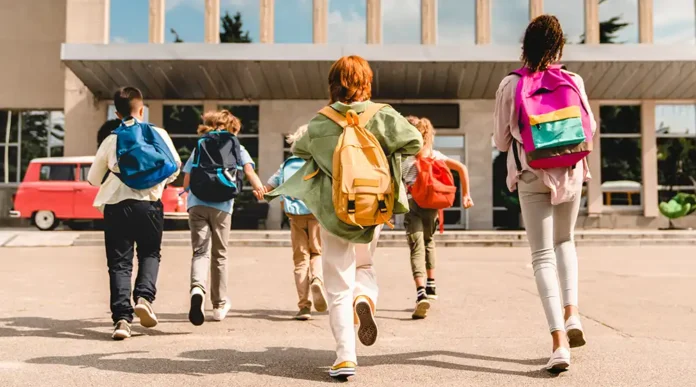
September is always a somewhat peculiar month.
Summer draws to a close, the city fills up again, traffic returns to the streets, and for thousands of children and young people, something new begins almost simultaneously.
In my family, too, there are two such “beginnings” this year. One of my nieces went to school for the first time, while the other started kindergarten.
Over the past few days, I have often caught myself reflecting on how profound a shift it truly is for a child—something we casually refer to as “starting kindergarten” or “going to school.”
For us, it might just mean buying a new backpack, waking up slightly earlier in the morning, dropping them off, and checking in come evening: “So, how was your day?”
For a child, however, things are far more intricate: a new room, new faces, new rules, new sounds, a new social dynamic… And in kindergarten, there is an added layer of experience—the person who was almost always by their side now waves goodbye at the doorway and walks away.
One of my nieces is currently adjusting to kindergarten, the other to school. They are close in age, yet for their developing brains, these represent two very distinct challenges.
How different is this, really, from what an eighteen-year-old goes through when leaving home for the first time, moving from the provinces to Tbilisi, or traveling abroad to study?
Naturally, a three-year-old and an eighteen-year-old occupy vastly different developmental stages, yet both confront the same fundamental hurdle: turning an unfamiliar environment into a familiar one—and the human brain cannot accomplish that overnight.
The Brain Does Not Care for Uncertainty
You have likely heard people complain about how tedious routines are; perhaps you have uttered the words yourself. Yet for the brain, a routine is anything but dull.
When moving from room to room in our own homes, we hardly have to think. We know precisely where the doorway is, where the light switch sits, the hum of the refrigerator, and roughly what to anticipate over the next few minutes.
Our brains constantly draw upon past experiences to predict what happens next. In familiar surroundings, this predictive machinery runs effortlessly. The more foreign the environment, the harder the brain must work.
Now picture a toddler stepping into kindergarten for the very first time. As noted, countless “firsts” collide at once. On top of that, an adult they met mere minutes ago is telling them where to sit, when to eat, and what to do.
Meanwhile, their parent heads toward the exit, reassuring them: “I’ll be back soon.”
We know what “soon” entails. For a young child, the scenario is infinitely less predictable.
An unfamiliar and ambiguous setting demands intense computational effort from the brain. It must simultaneously process a flood of sensory data, evaluate potential threats, direct attention, and absorb novel social codes. Central to this process is the amygdala, which plays a pivotal role in processing emotionally salient stimuli and mobilizing responses to perceived danger. Under stress, the hypothalamic-pituitary-adrenal (HPA) axis activates as well, culminating in the release of cortisol.
It is cortisol that allows us not merely to observe a child’s adjustment from the outside, but to quantify the physiological stress response unfolding within.
Here, empirical literature paints an intriguing picture:
In a study published in 2022, researchers monitored 384 children transitioning from preschool to primary school. They tracked salivary cortisol levels across multiple time points: before school began, upon entry, and throughout subsequent weeks.
Two weeks prior to the start of school, there was no pronounced “anticipatory stress response.” However, during the initial two weeks of attending school, morning cortisol levels surged in the majority of children.
Researchers interpreted this as compelling evidence that entering formal schooling represents a normative, natural environmental stressor for young children.
Interestingly, children did not respond uniformly. After two months, stress responses in some had already subsided, whereas in others, elevation persisted longer.
A 2019 review synthesized data across eight independent studies measuring cortisol in children’s saliva or hair before and after the school transition.
The overarching pattern held: stepping out of a preschool setting into formal education was accompanied by a noticeable rise in cortisol. Furthermore, the authors observed that returning to baseline levels can take anywhere from three to six months for certain children.
The review underscored substantial individual variance. Among the moderating factors, researchers cited child temperament alongside maternal prenatal stress and anxiety.
In that sense, the colloquial phrase “they’ll get used to it” serves as a remarkably accurate neurobiological description. The organism is literally mapping out the new environment.
A room that felt completely alien on day one feels somewhat recognizable by day two.
A few days in, the child knows where the toys are kept, recognizes the caregiver, and might have gravitated toward a peer or two. They gradually assimilate the daily rhythm and, crucially, learn through lived experience that a parent leaves, but always returns.
The unknown gradually turns predictable. And the brain learns that staying on high alert in this space is no longer necessary.
That is the core architecture of adaptation.
“New” Does Not Mean the Same Thing to Every Child
Another noteworthy insight is that the magnitude of disruption matters.
In one investigation, cortisol levels were sampled one week prior to the transition from kindergarten to school and one week after.
The sharpest spikes were observed in children whose daily routines underwent the most radical disruption and who had minimal prior institutional preschool experience.
This is entirely logical. If a child already knows what it is like to leave home in the morning, spend several hours navigating peers and other adults, and await their parent’s return, starting school does not overwhelm them with entirely novel demands. The brain is already seasoned in managing transitions of that scale.
Lacking that baseline experience, the volume of change multiplies.
Hence, the question “How difficult should starting school be for a child?” carries no one-size-fits-all answer.
Two children can enter the exact same classroom, sit before the exact same teacher, and yet their bodies will register shifts of an entirely different magnitude.
Parents Struggle Too
There is another central figure in this equation: the parent.
It is entirely natural that leaving a three-year-old in unfamiliar surroundings feels wrenching—doubly so if the child clings, weeping and pleading with you to stay.
The dilemma is that children do not simply listen to the words we speak. They scrutinize our expressions, vocal cadence, and body language, leaning heavily on parental reactions to gauge whether an environment is safe.
We can easily say, “Everything will be fine,” but if that reassurance is paired with a protracted ten-minute farewell, repeated glances back, and visible distress, the child receives an entirely different signal:
If Mom or Dad is this terrified, perhaps there really is something to fear here.
Empirical studies consistently demonstrate that a child’s adjustment is not governed solely by their individual traits. Family climate and parental emotional states are inextricably tied to the process. For instance, in the aforementioned review of cortisol studies during school transitions, maternal prenatal stress and anxiety emerged alongside temperament as meaningful predictors of a child’s physiological reactivity.
This does not imply that parental anxiety is the direct root of every obstacle a child faces. The science supports no such reductionist conclusion.
Nevertheless, parental emotional equilibrium forms part of the immediate atmosphere in which the child meets change. Striking the right balance of support is therefore far from easy.
On one extreme lies the dismissive stance: “Stop crying, what’s the big deal, you’re a big kid now.” On the other lies the instinct to insulate the child from every conceivable trace of discomfort. In truth, neither approach serves them well.
A far more constructive message to convey is:
“I see that this is hard for you. I am right here. And I know you can handle this.”
The first reaction invalidates their feelings; the second acknowledges their fear while preserving their trust in their own resilience.
School Is Not Merely a Larger Kindergarten
In my own circle, the contrast is especially striking this year: one niece is finding her footing in kindergarten, while the other has entered school.
A child might have adapted seamlessly to preschool yet still face real friction when entering primary school. That is entirely normal.
School does not simply bring a change of venue; it alters the fundamental demands placed upon the child.
Now they are expected to sustain focus for longer intervals, retain and follow multi-step directions, regulate physical impulses, organize materials, shift smoothly between tasks, negotiate peer dynamics, and accept that their efforts are routinely evaluated.
Underpinning all of this are executive functions.
This is not a single, isolated skill, but an umbrella term encompassing several interconnected cognitive operations: working memory, attentional and behavioral inhibition, planning, and cognitive flexibility (the capacity to switch rules or task sets).
Crucially, these faculties do not arrive pre-packaged at birth.
A comprehensive 2010 review in Child Development demonstrated that while executive functions emerge in early childhood, their maturation spans the entirety of childhood and adolescence. Moreover, their component processes—such as inhibitory control, working memory, and set-shifting—do not mature at identical rates.
Expecting an adult standard of self-regulation from a first-grader is as unreasonable as forcing them into adult-sized shoes and reprimanding them for stumbling.
Neuropsychologists frequently emphasize that during the opening weeks of school, our primary metric should not be how rapidly a child masters reading or how few errors they make in basic arithmetic. First and foremost, they must find their footing and establish a sense of belonging.
They need to bond with the teacher, acclimate to peers, decode the rules, build a rhythm, and, above all, feel that this space is safe and predictable.
Genuine academic learning can only take root once that foundation is laid.
“I Don’t Want to Go” Isn’t Always Put into Words
Even as adults, we often struggle to articulate why we feel out of sorts. For a young child, verbalizing distress is vastly more difficult.
A child will rarely announce: “I am having a hard time adapting to this new environment.”
Instead, their stomach might ache every morning… or their head might throb. Sleep patterns may fracture, irritability may spike, tears may flow at the door, or they may arrive home so thoroughly depleted that a trivial frustration sparks an outburst.
At times, they may temporarily revert to behaviors characteristic of a younger age.
In school-related stress research, marked school refusal, avoidance patterns, and heightened emotional dysregulation are viewed as potential indicators of adaptation hurdles.
An isolated occurrence does not signal deep pathology; recurring patterns, however, warrant thoughtful attention.
Here lies a crucial caveat:
Adaptation has no universal timeline.
This is readily apparent in neuroendocrine studies: some children recalibrate their stress responses relatively quickly, while others sustain elevation over longer spans. As systematic reviews observe, normalizing cortisol back to baseline can take anywhere from three to six months in certain cases.
Naturally, this is not a license to dismiss months of severe distress as mere “growing pains.”
What matters most is not circling a rigid date on the calendar, but observing the trajectory.
If distress steadily wanes compared to the opening days, if the surroundings grow familiar, and the child settles into the daily cadence, adaptation is unfolding as it should.
Conversely, if acute anxiety remains fixed or escalates—disrupting sleep, appetite, learning, social relationships, and everyday functioning—seeking counsel from a specialist is entirely prudent.
And Then You Turn 18
One might assume the narrative concludes here. We navigated kindergarten. We made it through school. We mastered acclimating to new spaces.
At eighteen, a person is legally an adult. They might pack a suitcase and move from a quiet province to Tbilisi, or board an airplane and find themselves hours later in a metropolis where the streets, the faces, and perhaps even the language are entirely foreign.
And suddenly, the cycle begins anew.
An eighteen-year-old student is certainly not a three-year-old toddler. They possess life experience, far more sophisticated cognitive architecture, and broader psychological toolkits to regulate emotion.
Yet the core dynamic remains strikingly similar.
Once again, you must decode how an unfamiliar space operates. You must map routes, meet people, construct a social circle, establish personal routines, and resolve daily complications on your own.
Added to this is a profound structural shift: the support system that quietly resolved life’s logistical friction is no longer right beside you.
Here, too, developmental neuroscience offers grounding context.
A pervasive myth has long circulated that the human brain “finishes developing at age twenty-five.” In truth, there is no magical date upon which the entire brain suddenly declares itself complete.
Different neural systems mature along distinct developmental timelines.
What research does affirm is that neural networks governing cognitive control, working memory, decision-making, and behavioral regulation continue refining throughout late adolescence and early adulthood. Both localized cortical efficiency and long-range structural connectivity keep strengthening.
Reaching legal age does not mean the brain receives a definitive adult software patch at the stroke of midnight.
Legal adulthood arrives on a calendar date; neurobiological development adheres to no such calendar.
Independence is an ongoing developmental process, precisely like adaptation.
Where Does Support End and Over-Accommodating Begin?
For a parent, identifying this boundary is perhaps one of the most difficult challenges of all.
If a child has a conflict with a classmate, should we intervene?
If a misunderstanding arises with a teacher, should we take over the conversation?
If an eighteen-year-old at university hits a snag, should we step in and resolve it for them?
At times, the answer is undoubtedly yes; but not always.
Anxiety literature highlights the concept of family accommodation—a pattern in which family members alter their own behavior to alleviate a child’s distress, inadvertently shielding them from challenging or anxiety-provoking encounters.
In the short run, this appears effective: the child bypasses the immediate trigger, and situational anxiety drops.
Yet this is where the developmental paradox lies: if a child is continually insulated from distress, they are denied the experiential evidence that they possess the capacity to endure and resolve it.
Empirical studies consistently link higher levels of family accommodation to greater symptom severity in childhood anxiety disorders, with an exceptionally pronounced link to separation anxiety.
This does not mean brushing a child off with: “It’s your problem, figure it out.”
Healthy scaffolding is not synonymous with stepping in to solve the dilemma on their behalf.
Perhaps that is the decisive distinction: walking beside the child so they can take the step themselves, rather than taking the step in their place.
We Cannot Walk This Path for Them
For one of my nieces, this journey began at the kindergarten door this September; for the other, at the school gate.
Over the coming years, they will stand before countless more doors: new classrooms, unfamiliar peers, university auditoriums, a first job, perhaps a foreign city or country.
Each time, the scale will differ, but the underlying neurobiology remains the same: an unfamiliar environment taxes the brain with high computational demand, physiological stress responses flare, and gradually, through repeated exposure, the unfamiliar settles into predictability.
Our duty as adults is not to sterilize life of every friction. Stress is not an inherent enemy.
The studies capturing surges in cortisol as children enter school remind us of this: a physiological stress reaction is not a pathology. It is an adaptive mechanism primed to help an organism navigate a challenging, high-demand environment.
Concern is warranted only when that response becomes dysregulated, prolonged, and disruptive to daily functioning.
We can stand beside them. We can validate their fears. We can lend predictability to their routines and step in when genuine assistance is required.
Yet we cannot step into kindergarten on their behalf, we cannot sit in the first-grade classroom for them, nor can we pack their entire lives into an eighteen-year-old’s suitcase and guarantee a seamless ride.
Ultimately, it is the brain itself that turns the unfamiliar into the known. Real independence begins precisely there—in that quiet, earned realization after facing something intimidating:
“It was hard at first, but I did it.”
