In the modern world, health is no longer solely about medicine. It has evolved into a complex, interconnected ecosystem where the well-being of humans, animals, plants, and the environment is viewed as a single, unified system. This exact vision forms the foundation of the “One Health” approach—an interdisciplinary field that addresses the most complex challenges of the 21st century.
The institutionalization of this concept in Georgia began in 2024 with the establishment of the One Health Institute at the University of Georgia’s School of Science and Technology. The institute is part of the university’s scientific hub, which unites three key disciplines: molecular medicine, One Health, and synthetic biology.
A New Institute, New Infrastructure
The creation of the institute was far from a mere formal step. Relying on its own resources, the university initiated the development of modern scientific infrastructure and has already established a functional genomics and proteomics in silico laboratory.
Currently, a laboratory for microbial genetics and ecology is in its formative stages, with full operations scheduled to launch in the summer of 2026. This signifies the creation of a dedicated space in Georgia where modern bioinformatics and molecular biology seamlessly intersect.
The Institute’s Research Focus
The institute’s research focus is already clearly defined. Its ongoing projects cover:
-
The evolutionary dynamics of antimicrobial resistance (AMR) genes.
-
The identification of microbial networks driving the spread of resistance.
-
The analysis of various DNA types and the analytical modeling of genomes.
-
The genomic study of industrially significant bacteriophages.
According to the Institute’s Director, Mamuka Kotetishvili: “Our research demonstrates the trajectories of resistance spread and evolutionary trends, as well as the developmental characteristics of bacteriophages. These phages can be utilized in food safety, therapeutics, veterinary medicine, biocontrol, and environmental protection.”

A portion of these studies has already been published in international scientific journals, while others are currently undergoing peer review.
International Recognition and New Support from the U.S.
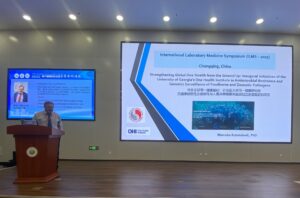
The institute’s international integration is advancing rapidly. In 2025, it became a member of the European One Health Association. Within the framework of this collaboration, three of the institute’s scientific papers will soon be presented at the association’s international conference in Madrid. This underscores that Georgian science is actively engaging in the global One Health network.
Adding to this success is another significant milestone: the One Health Initiative—an international expert group based in the United States—featured information about the University of Georgia’s One Health Institute on its website, officially endorsing its work.
This backing significantly elevates the international visibility of both the university and the institute, confirming that Georgian research is now firmly embedded in the global scientific community.
Strong Partners Within Georgia
The One Health approach cannot thrive in isolation within a single field. Consequently, the institute is actively building a robust partnership network at the national level.
Memoranda of Understanding with Georgia’s National Center for Disease Control (NCDC), the Scientific-Research Center of the Ministry of Environmental Protection and Agriculture, and the G. Natadze Scientific-Research Institute of Sanitary, Hygiene and Medical Ecology strengthen the operations of the One Health Institute and facilitate the execution of its future vision.
These partnerships lay the groundwork for seamlessly connecting research directly with public health, agriculture, and environmental protection.
Future Plans: An International Workshop in Georgia
The year 2026 has started exceptionally well for the institute—in just the first four months, four scientific articles have already been published in leading global journals.
The institute is actively working to expand new international collaborations with EU nations and U.S. institutions. Backed by the European One Health Association, an international workshop is planned to be held in Georgia this autumn, bridging the gap between the European and Georgian scientific sectors.
One Health is no longer merely a scientific term; it is a practical response to contemporary challenges: pandemics, environmental shifts, food security, and antibiotic efficacy.
The University of Georgia’s One Health Institute, in turn, is transforming Georgia into an active and influential player in this critical global process.