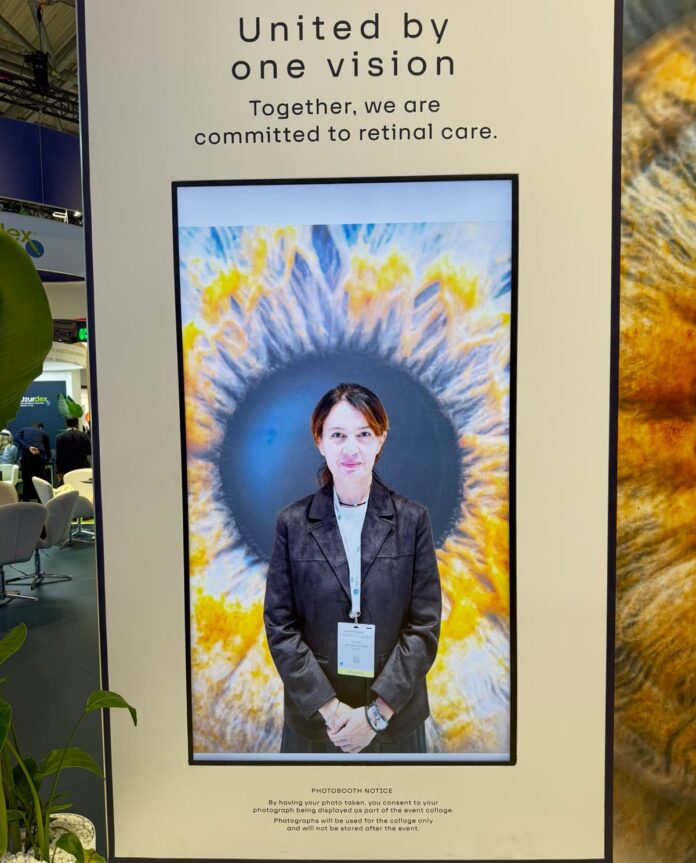
The International EURETINA Congress brought together world-leading specialists, researchers, and innovators in the field. The event’s primary focus was exploring cutting-edge advancements in diagnosing, treating, and restoring vision for retinal conditions. The scientific program placed particular emphasis on age-related macular degeneration, gene therapy, artificial intelligence, retinal imaging, and surgical innovations.
 At the congress, ophthalmologist Tina Jikurashvili represented Georgia as a nation actively implementing and utilizing state-of-the-art approaches to treat age-related macular degeneration. During the event, she had the opportunity to explore firsthand the latest global trends in the management of retinal diseases.
Tell us about the EURETINA Congress. What major breakthroughs would you highlight?
This year’s EURETINA Congress in Vienna proved truly outstanding, impressive, and packed with innovation. In terms of managing retinal diseases, I would highlight three major, revolutionary directions:
1. Next-generation, extended-duration anti-VEGF therapies: These include high-dose aflibercept and faricimab. Particularly impressive is the continuous-delivery intraocular micro-implant (Susvimo), which delivers small doses of medication continuously for six months. As a result, patients only need to visit a doctor and refill the implant twice a year, dramatically reducing the treatment burden.
2. Managing late-stage dry macular degeneration (geographic atrophy): The emergence of complement inhibitors (pegcetacoplan, avacincaptad pegol) has made it possible to significantly slow the progression of what was previously an untreatable disease.
3. Innovative approaches to treating inherited dystrophies: Advances in optogenetics and genetic engineering offer real and promising prospects for managing advanced, severe cases.
Alongside these fundamental medical breakthroughs, artificial intelligence was showcased at this year’s EURETINA congress as an everyday tool for physicians: it now calculates fluid in retinal layers with micron precision and predicts the progression pathways of atrophy. AI-powered robotic platforms (such as Preceyes, LUCA, and others) are deployed for ultra-high-precision surgical procedures, including gene therapy delivery and vascular cannulation. Large language models (LLMs) and platforms like RetinAI are already assisting clinicians in decision-making, risk assessment, and the rapid stratification of patients for clinical trials.
At the congress, you represented Georgia. Where does our country currently stand in the treatment of age-related macular degeneration, and how have modern approaches transformed the standard of care?
In Georgia, retinoscopy is advancing in full compliance with international guidelines. Today, world-class diagnostics are available here—high-resolution OCT (optical coherence tomography) and OCT angiography, allowing us to detect diseases at the earliest, asymptomatic stage.
In treatment, we strictly adhere to the modern “Treat and Extend” protocol. This means a fully tailored approach: we gradually extend the intervals between injections, thereby shielding patients from recurrence and preserving their vision over the long term.
At the same time, we are actively introducing cutting-edge vision rehabilitation methods for patients with dry-form conditions. Since injectable treatments for geographic atrophy are currently unavailable here, we achieve disease stabilization through photobiomodulation.
Meanwhile, when the retina is already damaged and a patient experiences low vision, we utilize specialized optical/rehabilitative low-vision glasses. These enable individuals to move around independently once again, read, recognize loved ones, and maintain their social and professional lives.
One of the most promising fields generating significant interest is gene therapy. What stage is this field at today, and what does the latest evidence show?
Gene therapy is the near future of ophthalmology. Its core concept is “a single intervention with long-lasting results.” For rare inherited diseases, an FDA-approved drug (Luxturna) has already been available for years.
As for age-related macular degeneration (AMD), gene therapy in this area is currently undergoing Phase II and Phase III clinical trials (such as RGX-314 and 4D-150).
The latest evidence shows that the gene delivered into the cell compels the eye to produce the therapeutic protein itself, slashing the need for repeat injections in patients by 70–85%. While this approach is not yet routine practice, it is poised to substantially and fundamentally transform the standard of care for retinal diseases in the coming years.