


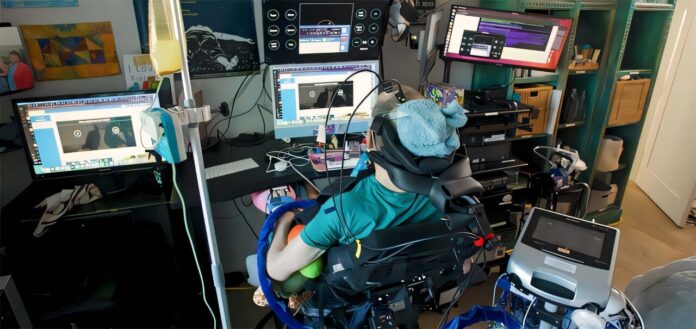
For years, the brain-computer interface (BCI) existed solely as a laboratory-bound scientific concept, requiring the constant intervention of researchers to function. However, a new study published in the journal Nature Medicine confirms that scientists have crossed this critical threshold. A patient with severe paralysis caused by amyotrophic lateral sclerosis (ALS) was able to fully connect their brain to the digital world and return to professional activity from the comfort of home, entirely without external assistance.
Neurosurgeons at the University of California, Davis (UC Davis), in collaboration with Massachusetts General Hospital and Brown University, developed a system that translates neural signals into text and cursor movements. The device was implanted into the area of the brain responsible for coordinating speech. Utilizing advanced algorithms, the system decodes the neural activity generated when the patient attempts to speak or move, enabling full control over a personal computer.
Clinical trial participant Casey Harrell, 47, who suffered from complete limb weakness and severe speech impairment due to the disease, used the new technology at home on a daily basis for over two years. During this period, he communicated more than 183,000 sentences and nearly 2 million words using the BCI system. Notably, his communication speed averaged 56 words per minute, setting a record for neuroprosthetics of this class.
The primary clinical value of this model lies in its unprecedented accuracy, long-term stability, and the complete autonomy it grants the patient. During controlled testing, the system demonstrated a 99% word decoding accuracy, while the patient himself rated 92% of the decoded sentences as entirely correct. Furthermore, when generating speech from text, the software utilizes a digital voice tailored to mimic the patient’s authentic, pre-illness voice, adding a vital emotional component to the therapy.
Conventional assistive technologies are becoming a thing of the past; stability achieved at the neural level allows the patient to manage a computer independently for up to 12 consecutive hours—sending emails, browsing the web, and maintaining employment despite paralysis. According to the researchers, the 3,800 hours of neural recordings collected from Harrell at home represent the largest single-neuron resolution dataset in medical history, paving the way for even more sophisticated neuroprosthetics in the future.
