


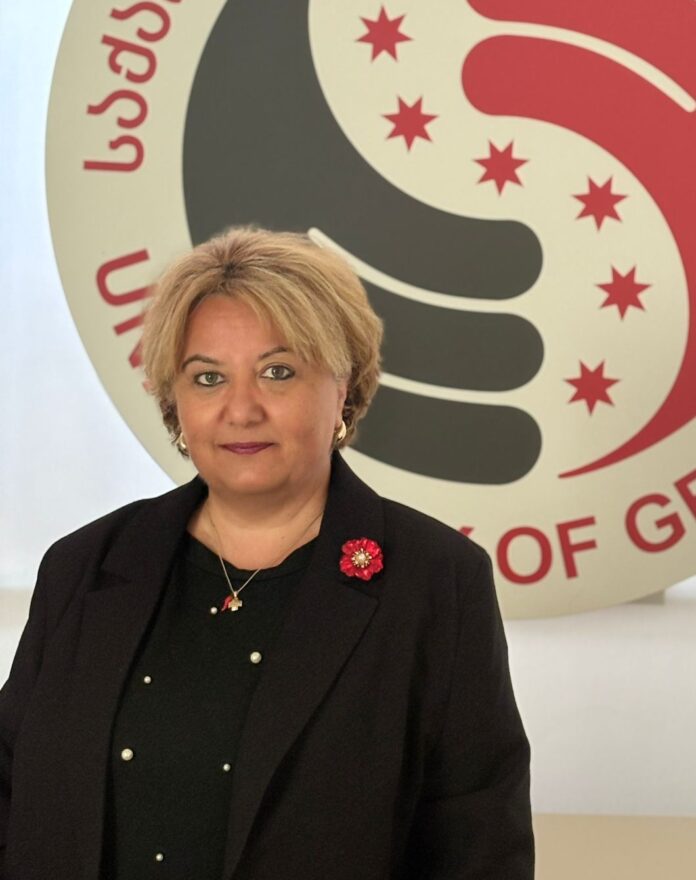
For a long time, nursing was perceived within the healthcare system as merely an auxiliary, technical function. However, modern medical standards require a nurse to possess not only practical skills but also academic training and clinical reasoning. It was with the idea of this fundamental transformation in mind that the Bachelor of Nursing program at the University of Georgia was created, headed by Maia Gogashvili.
The curriculum, authored by her with the involvement of international experts, is based on EU directives and American educational models. In this interview, the respondent speaks about a new era of nursing education, the importance of the nurse as the primary guarantor of patient safety, and the global challenges currently facing Georgian medicine.
How was the Bachelor of Nursing program established at the University of Georgia, and which international educational standards became your primary guide?
The University of Georgia turned out to be the first and only educational space that expressed readiness to introduce innovative teaching in the field of nursing. We began working on the program at the end of 2011; in 2012, the English-language program successfully passed accreditation, and in 2014, a Georgian-language track was added. It is noteworthy that nursing is a regulated profession in 97% of the world’s countries. Georgia was among the few exceptions where this field remained outside of normative control; however, as of 2024, the profession has become regulated in our country as well.
The structure of the bachelor’s program is primarily based on EU directives. Since this field is strictly regulated, the directives define in detail the number of credits, the criteria, and the competencies that a student must possess. As a participant in the Bologna Process, we use an identical credit system, which ensures compatibility with European standards. Furthermore, the program fully meets the Level VI criteria of higher education provided for by Georgian legislation.
International experts were also actively involved in the program development process, including Morag McCormick from Scotland and Michael Weinhara from Germany. Additionally, American experience is widely shared—as the author of the program, I received specialized education at Emory University in the direction of creating nursing baccalaureate models. Consequently, our curriculum represents a synthesis of international standards and local requirements.
How does a bachelor’s program differ from traditional vocational training, and what specific competencies does it provide to the student?
In Georgia, we have developed sector benchmarks for higher education in nursing, which define thirteen core competencies for a nurse with a higher education. Interestingly, if we compare the competencies of a doctor and a nurse, we find that they differ in only two or three main aspects. For example: while the doctor’s function is to prescribe medicinal therapy, a bachelor-level nurse is required to have deep knowledge of pharmacology and provide constant monitoring. Furthermore, the foundation of a nurse’s activity is the complete management of the nursing process. Almost all other competencies are nearly identical, which indicates that requirements for a modern nurse are quite high—they must possess both fundamental theoretical knowledge and refined practical skills.
Regarding the difference between a practical nurse’s vocational program and a bachelor’s degree, this issue is often misperceived in Georgia. According to global practice, a bachelor’s-prepared nurse is a professional who independently carries out patient assessments, makes nursing diagnoses, and establishes individual care plans. Additionally, a bachelor’s degree grants a nurse the unique competency of patient education; however, this does not simply mean consulting or giving advice—it is a formal educational process that requires knowledge of the foundations of pedagogy.
It is also important to realize that the status of a bachelor-prepared nurse does not exempt a specialist from daily patient care or hygiene procedures. On the contrary, they integrate this process with the continuous assessment of the patient’s condition. Furthermore, the bachelor’s program includes academic foundations such as research methodology, sociology, and psychology. These materials are quite extensive and create the necessary base for subsequent levels of education—master’s and doctoral studies. Consequently, a bachelor’s education shapes a nurse not only as a practitioner but as a clinical thinker and a researcher.
Why is it essential for a nurse in the modern hospital sector to be academically trained rather than just possessing technical skills?
Nursing has become so complex today that it is impossible to compare it even to the practice of half a century ago. A modern nurse must possess multi-profile knowledge, which includes both deep clinical training and the ability to work with high-tech equipment.
The education of a bachelor-prepared nurse is directly reflected in the quality of medical services and patient safety. A nurse, in fact, is the “last barrier” between the patient and a possible medical error. Even in the case of a physician error, it is precisely the academically trained nurse who has the competence to notice the inaccuracy, react, and prevent a fatal outcome.
One of the greatest challenges in Georgia today is nursing pedagogy. Often, nurses are still taught by doctors, which hinders the development of the field, because nursing assessments and specific care protocols should only be taught by a professional in that field. The University of Georgia has the resources to have nursing educators trained at an international level who know the nuances of nursing exactly.
It is also important to realize that specialization—be it surgical care, psychiatry, critical care, or primary healthcare—is only possible on the basis of a bachelor’s education. Vocational training is not sufficient for those high-level competencies required by international standards. This is not “reinventing the wheel”; this is a global practice that Georgia must also join if we wish to maintain a high-quality and safe healthcare system.
When we talk about the advantages of academic education, it is not just a theoretical opinion. Specifically, what does international statistics tell us—how does a bachelor-prepared nurse change a patient’s chances of survival and clinical outcomes?
In international practice, there are fundamental studies that directly confirm the link between a nurse’s education and patient survival rates. One of the largest-scale retrospective studies, conducted by professors from the University of Turku (Finland) in nine European countries, shows that in clinics where the majority of registered nurses (approximately 60-70%) had a bachelor’s or higher academic degree, patient mortality was on average 7% lower. Beyond survival rates, academic preparation directly reflects on such important criteria as the reduction of patient readmission within a week and the prevention of post-operative complications.
In Georgia, we have many challenges in this regard. A study conducted as far back as 10 years ago, in which more than 2,400 respondents (patients, doctors, and nurses) participated, showed a rather deplorable picture: almost 90% of patients believed that assessing vital signs or caring for hygiene was not within a nurse’s competence. This indicates that the public did not have the proper experience or information regarding what professional nursing care should entail.
Today, we are planning a new, in-depth study where we will compare the care provided by vocational and bachelor-prepared nurses. This will help us see specifically what components our patients are lacking today and how this deficit can be filled through academic education. The results of the study will confirm once again that a qualified nurse is not just a technical executor, but the primary guarantor of patient safety.
Given that Georgian-language nursing textbooks are practically non-existent, how do you handle this problem during the teaching process, and how do you ensure students have access to the latest materials?
There are attempts to create modern Georgian-language literature in nursing—for example, several books were prepared with the support of the European Bank for Reconstruction and Development and the involvement of Evex Hospitals—however, they fall significantly short of modern requirements. Translating professional literature is not just a labor-intensive process; it is associated with colossal finances and strict copyrights. The University of Georgia attempted to purchase translation rights, but the printing requirements of international publishers increased the cost of a single book so much that its realization became practically impossible.
Consequently, we chose another path: despite the fact that the program is in Georgian, knowledge of the English language is mandatory for students during the entrance exams. Lectures, presentations, and auxiliary materials are prepared in the Georgian language, but the primary professional literature remains in English.
This decision is strategic: progress in the medical field is so rapid that a translation simply cannot keep up with the latest scientific achievements and guidelines. If we want our students to be globally competitive, they must receive information from the primary source, in the language in which modern medical literature is created. Thus, we offer students a Georgian-language academic base reinforced by the latest international resources.
Theoretical knowledge is important, but nursing is unimaginable without practice. What resources does the university offer students—do you have simulation centers where they train before entering a real clinical environment?
Our students indeed encounter an outstanding simulation environment equipped with the latest mannequins and simulators. We are especially proud of the independent study space at the Kavtaradze campus. This is a place where a student can go at any time and practice independently to refine the practical skills they acquire during laboratory sessions. Each workstation, for example—a corner designated for urinary catheterization—is equipped with a monitor showing the procedure provided for by the protocol. The student follows the instructions step-by-step and repeats the manipulation as many times as needed to master it perfectly.
Beyond simulation teaching, we have a completely different model of clinical practice based on American practice. Since we do not yet have registered bachelor-level nurses in Georgian hospitals whose work a student could observe, our clinical mentors serve as both teacher and “translator” simultaneously. Clinical practice lasts 7-8 hours a day, and every day is loaded with a specific, pre-written plan.
Teaching is gradual: if in the first week a student learns the nursing assessment of the head and neck in the university’s “simulation hospital,” once they arrive at the clinic, they perform this on a real patient and fill out the corresponding nursing documentation. The following week, lung and heart auscultation, chest examination, etc., are added to the program.
At the University of Georgia, we developed a special course for training nursing clinical practice mentors, which we will soon offer to other universities as well. Our goal is for high-quality nursing education to be implemented throughout the country. This is principled not only for local healthcare but also for the country’s prestige—any student who leaves Georgia should be able to successfully pass international licensing exams and continue their professional activity abroad.
Despite such importance of the baccalaureate, why is there no mass demand for this degree, and what hinders nurses in Georgia—financial barriers, lack of time, or a lack of motivation?
You have touched upon a very painful issue. The decrease in demand for nursing in Georgia is, first and foremost, due to the low status and inadequate appreciation of the profession. Low pay, the absence of social guarantees, and difficult working conditions make this field less attractive to young people. When a person lacks a sense of social fulfillment, they lose motivation.
The University of Georgia has a Georgian-language bachelor’s program, but student interest over the last 10 years was minimal. Many of them would stop their studies shortly or transfer to other faculties through mobility. One reason for this was that the state only funded vocational education, while the baccalaureate remained absolutely un-incentivized. Today, the picture is changing—free tuition for nursing has been introduced in state universities, and it is precisely now that it will become clear to what extent the financial factor was the primary barrier.
Beyond compensation, it is vital to rethink the nurse’s role in healthcare management. International studies confirm that the involvement of nurses in hospital management and budgeting sharply increases their self-esteem and labor productivity. We have nurses who are second to none and have the potential to be world-class professionals, but they need support, including so-called “bridge programs” that would allow current practical nurses to upgrade their qualifications and receive a bachelor’s degree in a short period of time.
The success of our international students—more than half of whom today work in leading clinics in America and Europe—confirms that we provide nursing education at an international level. However, it is disheartening that local students take less advantage of this opportunity. Unless the status and appreciation of the nurse change systemically, it will be difficult to save the field through education quality alone.
What lies beyond a bachelor’s diploma? What real perspectives does this degree open for a nurse—be it in the direction of a master’s, research, or clinical management?
A bachelor’s degree is only the starting point of the enormous career opportunities this profession offers a person. First and foremost, it is an academic path: there is a catastrophic shortage of professional nursing educators in our field. A nurse cannot become a lecturer if they do not have a bachelor’s and subsequently a master’s degree. That is why we are planning to develop a special master’s program—Nurse Educator—which will lay the foundation for a tradition of nurses teaching nurses in Georgia.
Beyond academic activity, the baccalaureate opens the path toward narrow specializations, scientific research, and doctoral studies. Modern medicine relies on evidence-based practice, which is impossible to achieve without nursing research. This research, in turn, directly reflects on the quality of patient care.
Additionally, a nurse’s activity is not limited only to clinical work. Management and leadership positions are open to specialists with a bachelor’s degree. Many high posts in the World Health Organization (WHO) are held by individuals with a nursing education. They participate in the development of healthcare policy, work in the direction of forensic expertise, and manage large medical institutions. In Georgia, we only have the “embryo” of these opportunities, but the international market is absolutely open and provides boundless prospects for growth.
