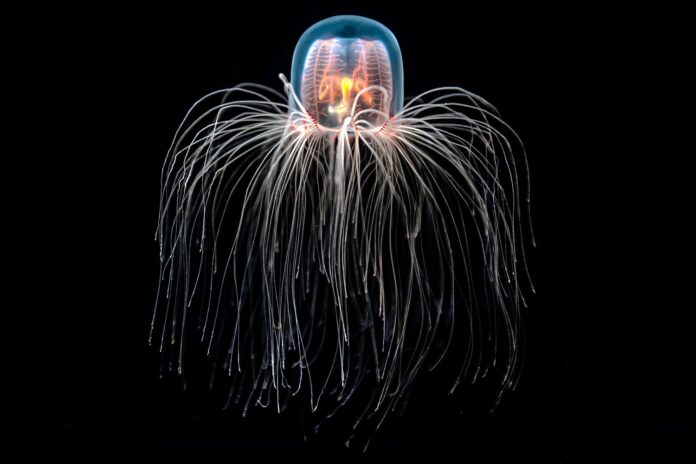
The small, transparent jellyfish Turritopsis dohrnii possesses a unique ability: it can return to an early stage of development and restart its life cycle. Scientists are studying its cellular mechanisms to determine whether similar regenerative processes could be stimulated in human cells, potentially helping medicine combat age-related diseases.
According to Maria Miglietta, a biologist at Texas A&M University, when exposed to stressful environmental conditions, extreme temperatures, starvation or high salt concentrations in water, the jellyfish does not die. Instead, it loses its shape, transforms into a mass of cells and reverts to an early developmental stage known as the polyp stage, from which new jellyfish can later emerge.
“From a single jellyfish that does not die, we get a colony capable of producing hundreds of new organisms. In theory, each of them can restart its life cycle and rejuvenate indefinitely,” Miglietta explains.
Italian biologist Stefano Piraino discovered that, during the jellyfish’s rejuvenation process, its tissues revert to a stem-cell-like state (a process known as transdifferentiation), after which they transform into other types of cells as needed by the organism. This phenomenon is entirely unique in the animal kingdom. Although some lizards and amphibians can regenerate lost body parts, no other species is known to be capable of returning from adulthood to an early developmental stage.
According to Michael Koldobskiy, a pediatric oncologist at Johns Hopkins University, the goal of scientists is not to return humans to an embryonic stage. The main objective is to treat age-related diseases by renewing cells and tissues.
If scientists identify the molecular “switch” responsible for rejuvenation in the jellyfish, the same mechanism could potentially work in humans. In the future, this approach could enable researchers to repair damaged tissues more rapidly and slow or halt degenerative diseases such as Alzheimer’s.
In 2022, researchers at the University of Oviedo in Spain compared the genes of Turritopsis dohrnii with those of closely related species that lack this ability. They found that the “immortal jellyfish” has significantly more genes involved in repairing mutations and damage accumulated with age. It also has enhanced mechanisms for maintaining telomeres (protective structures at the ends of DNA), which help protect its DNA from age-related deterioration, unlike what is observed in many other organisms.
Maria Miglietta and Michael Koldobskiy are currently working together to investigate whether the jellyfish’s regenerative mechanisms can be adapted for use in human cells. At the same time, researchers emphasize that, despite its ability to escape biological aging, Turritopsis dohrnii remains an extremely vulnerable organism in the wild. Predators, food scarcity and environmental changes pose constant threats to its survival.