


The field of medicine is a world of wonders. From the very first days of medical school, we are taught that this is a sphere where anything can happen. As fascinating as that may sound, we must always remember that every patient’s case is unique. There is always a possibility that their condition may not fit within the broad frameworks that a doctor might have used to help countless patients over the years. This is precisely when listening to a different perspective becomes relevant—involving another professional in the matter and benefiting from their experience and professional insight. Put simply: a Second Opinion.
This is the mission served by the Medveritas Global portal, where patients are assisted in correctly managing complex medical cases. Highly qualified doctors practicing in America provide professional second opinions regarding their conditions.
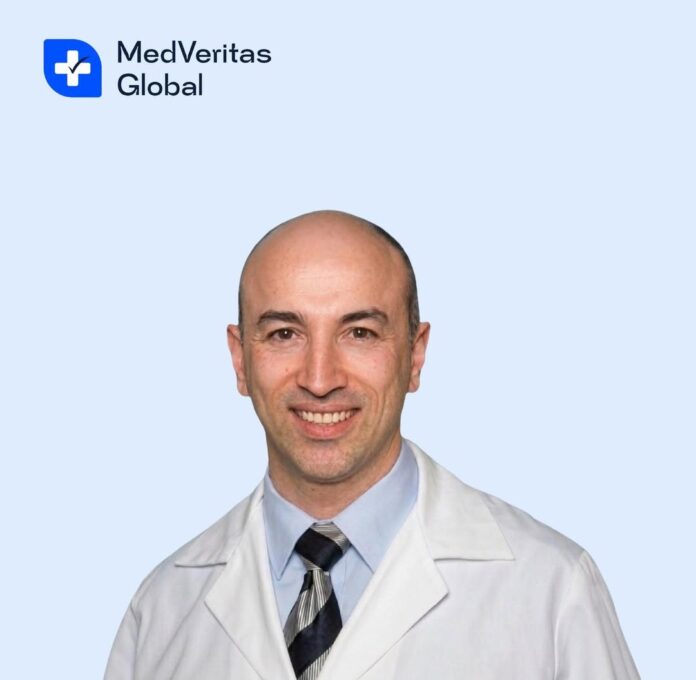
To discuss the mission of Medveritas Global, the importance of a second opinion, and the American experience, we had the honor of interviewing Nikoloz Chitaia, an endocrinologist practicing in the USA. Dr. Nikoloz is a graduate of Tbilisi State Medical University and was among the first to continue his studies in an American residency program following graduation—specifically at Emory University in Internal Medicine, and subsequently at the University of Florida in Endocrinology, where he has been actively practicing medicine for many years.
— Could you tell us a little about Medveritas? What is your goal, and what are your thoughts on the importance of a second opinion?
— The goal is to have a portal where a patient can always hear a “second opinion” or simply a different perspective. Over the years, there have been frequent cases where patients contact doctors practicing abroad through various social networks to ask for advice or an opinion, as their cases are often out of the ordinary.
Unfortunately, many of these patients visit numerous foreign clinics in search of answers, which is associated with many difficulties and, often, great confusion regarding obtaining an accurate diagnosis. Therefore, the goal is for the patient to receive a qualified recommendation upon request and no longer need to travel between centers of different specialties. It is what they call a “One-stop shop,” where you can clarify everything and get guidance from start to finish in one place. The main thing is always to provide the patient with an in-depth analysis of the situation, guide them, and set them on the right path.
To expand on the importance of the second opinion itself, the concept of a “Second Opinion” is excellent because it helps everyone—both the patient and the doctor—to better understand the situation. On one hand, it is always interesting to hear a colleague’s opinion if assumptions do not coincide; on the other hand, if the second opinion is identical to the first, it further emphasizes the doctor’s professionalism, and the patient feels more confident in the accuracy of the diagnosis and therapeutic strategy. In my personal practice, a second opinion is particularly interesting when dealing with a rare disorder, as in such cases, the opinion of every professional is doubly interesting to me. This is part of healthy medicine.
— American medicine: What makes it a world leader? What accounts for the fact that the FDA has such a massive influence on the pulse of global medicine?
— The advantage lies in the fact that the healthcare system is built by both doctors and representatives of other professions; consequently, it works seamlessly to create maximum conditions for a medical professional to do their job. The second advantage is the volume—the flood of information and innovation that we are the first to receive. The system is designed so that companies themselves inform you about their latest findings, which opens new doors.
As for the Food and Drug Administration (FDA), it is a large bureaucratic organization that mitigates risks as much as possible to ensure that no incidents occur during the implementation of a new drug or treatment method. This is why we might witness the appearance of a particular medication in Europe earlier, even though American doctors already possess thorough knowledge about it. This approach likely filters the sea of information we interact with daily.
— What can you tell us about the field of endocrinology? What challenges are associated with an endocrinologist’s daily routine?
— Endocrinology, our field, is primarily based on laboratory and objective data. Laboratory and technology have developed to such an extent that there is no longer a difference between Europe, America, and Georgia. You can perform any test, and yet, whatever the analyzer cannot do can easily be sent to another laboratory.
Therefore, performing an endocrinologist’s work via telemedicine is entirely possible, since the main challenge is the proper ordering of tests and the correct interpretation of results according to context. This is what determines the definition and effectiveness of future therapy.
Today, so many different analyses are freely available that a patient might initially get confused by this abundance. The doctor’s mission is to navigate this abundance and use these opportunities correctly. I would say that if we previously had to operate in a deficit of data, we now have to deal with a flood of it, which is actually—as Americans call it—a “good problem.” After all, abundance is better than deficit in every way.
— How does the process of requesting a second opinion work, and how much time does it take to receive a comprehensive answer?
— The main thing is to provide the service to the patient as simply as possible. Given the reality in Georgia, this involves approximately a one-week timeframe. It happens through an online link where the interested patient schedules an appointment, and we meet them via telemedicine.
The one-week period is necessary because we are not talking about a new patient, whose management from scratch is always simpler, but rather a patient whose problems have accumulated over years. It is necessary to analyze numerous tests and consultative conclusions before we provide our professional opinion. In reality, anyone can do this, but you must know what you are doing so as not to complicate the patient’s case further. We believe we have the experience and competence; therefore, we can handle such challenges well.
— What place does Artificial Intelligence (AI) hold in your profession or daily life?
— No one knows yet what AI will do, as it is developing so rapidly. In clinical medicine, at the patient level, I personally use it less because interpretation remains the doctor’s responsibility and no one else’s. However, where visuals are required—for example, on an X-ray—AI might see a nodule that the human eye might miss. The same applies to tomography or pathological slides. The machine sees better.
We will likely reach a point where it can also interpret hormones, as it can view millions of databases in a second. At this moment, in our field, it functions more as a comfortable assistant that reduces our labor and leaves us more time to do our actual work rather than spending a large part of our valuable time on bureaucracy. Also, I would highlight its immensely great importance in the development of individualized medicine. For example, an algorithm developed by MIT that learns a patient’s metabolic patterns makes life much easier for patients with diabetes.
Medveritas Global and professionals like Nikoloz Chitaia are creating a vital medical bridge between Georgia and the American experience. In an era where a lack of information has been replaced by a flood of it, a “Second Opinion” is no longer a luxury or a stigma—it is an integral part of modern, healthy medicine. With the help of telemedicine and innovative approaches, patients gain access to the precision and peace of mind that are crucial when managing complex diagnoses. Medicine is constantly evolving, yet its core value remains unchanged—to see the individual needs of each patient and set them on the right path, a task that Dr. Nikoloz and his team successfully fulfill.
