


Per- and polyfluoroalkyl substances (PFAS) are a broad class of synthetic fluorinated chemicals characterized by their exceptional resistance to water, oil, and stains. Due to their incredible persistence in the environment and living organisms, they have earned the nickname “forever chemicals.” Since the 1950s, the uncontrolled and widespread use of these substances has resulted in PFAS being found almost everywhere today—in the air, water, soil, dust, food, and everyday consumer products.
This reality is particularly concerning for infants and young children, as toxic substances enter their bodies through several pathways simultaneously: by constantly placing objects in their mouths, swallowing dust, and through direct contact with surfaces treated with PFAS.
Infants and young children represent a group particularly vulnerable to the harmful effects of PFAS. Relative to their body weight, they consume more food and water, frequently place various objects in their mouths, and their physiological pathways for eliminating harmful substances are still developing. These characteristics coincide with critical phases of immune, endocrine, and nervous system development, making early-life exposure to these substances far more dangerous than exposure during adulthood. From this perspective, textile products intended for children, including stuffed toys, may represent one of the less-studied sources of oral PFAS exposure.
Study Details
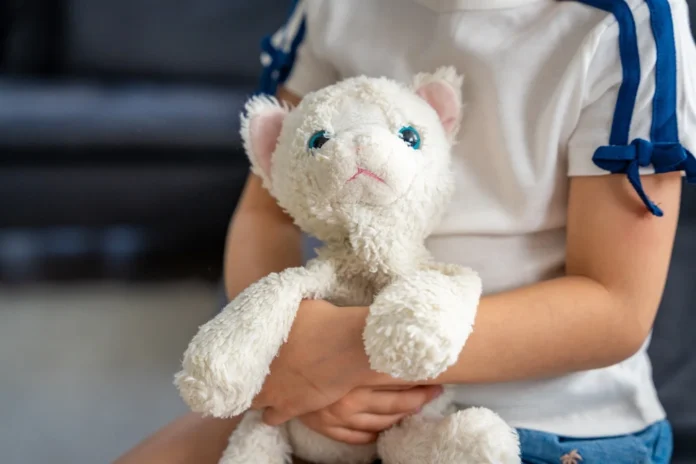
As part of the study, 18 stuffed toys available on the market were tested. Samples were taken from the parts of the toys that young children most frequently place in their mouths—ears, limbs, or corners. This approach accurately reflects reality, where children continuously chew on protruding parts of toys while exploring their environment.
For the laboratory experiments, toy fabric pieces (10 cm²) were placed in artificial saliva at human body temperature for 30 minutes, thereby precisely simulating a child placing a toy in their mouth. The PFAS substances were extracted from the resulting liquid using specialized methods (QuEChERS and LC-MS/MS systems) and analyzed using state-of-the-art instrumentation.
Scientists simultaneously studied 24 types of PFAS (including carboxylic acids, sulfonates, fluorotelomer derivatives, and others). To ensure the accuracy of the results, strict laboratory controls were implemented, and tests were also conducted to determine whether simply washing the toy reduces the migration of harmful substances.

Key Findings
As a result of the analysis, PFAS-group substances were detected in all tested stuffed toys. This means that under the conditions of the study, not a single tested product could be considered safe regarding the release of these substances. Migration rates varied considerably among the toys; however, short-chain perfluoroalkyl carboxylic acids stably dominated the overall picture, particularly PFHxA, PFBA, and PFPeA.
PFHxA proved to be the primary factor determining both the total release of PFAS () and the variations observed between different products. In a small subset of toys, levels were substantially higher than in other samples, and the excessive release of substances in these products was mainly driven by the high migration of PFHxA. This pattern indicates that the identified differences are largely explained by specific manufacturing technologies or treatment processes for a given product, rather than an even and uniform distribution of all compounds.
Exposure Assessment
In order to translate laboratory data into real-world risks for a child, the researchers calculated the daily intake of harmful substances that could enter the body. These calculations accounted for all variables: how often a child puts a toy in their mouth, the volume of saliva secreted during this time, the child’s body weight, and the rate at which substances are absorbed into the body.
The good news is that the estimated weekly intake of older-generation substances strictly regulated by the European Food Safety Authority (EFSA)—such as PFOS and PFOA—was below the permissible threshold for all studied toys. This means there is no cause for alarm regarding these specific compounds. However, the overall picture is less reassuring when observing each chemical individually.
In the toys where chemical release was highest, PFHxA was identified as the primary contributor, and in some cases, PFHpS also reached notable levels. In several toys, the total weekly intake of these harmful substances exceeded 10 ng per kilogram of body weight. This demonstrates that stuffed toys possess the potential to make a noticeable contribution to a child’s exposure to these substances—even if they are not the sole or primary source.
An analysis of the Margin of Exposure (MOE) brought the picture into even clearer focus. For most toys, this metric fell within safe limits, exceeding the recommended value of 100. However, in several toys where the content of PFHxA was particularly high, this figure dropped below the threshold of 100. This indicates that certain products warrant special attention and stricter quality control.
Comparisons with blood plasma data revealed that, in certain extreme cases, the estimated dose received from toys accounted for a significant fraction of the background exposure present in the body. Of course, this does not imply that toys alone are responsible for internal contamination, but the fact remains that stuffed toys represent a real and noteworthy factor in this process.
PFHxA and New-Generation Replacement Chemicals
When evaluating risks, particular attention is drawn to the widespread prevalence of PFHxA. This substance is increasingly used to replace older, banned toxic chemicals such as PFOA and PFOS. However, replacing the old with the new does not automatically equate to a reduction in hazard. The issue lies in the fact that short-chain PFAS dissolve and migrate much more readily in liquids and saliva. It is precisely this high mobility that increases the likelihood of a harmful substance easily transferring from a toy into a child’s body—even if the amount present within the product itself is not large.
Specialists are additionally concerned by the detection of 6:2 FTS in many toys. Under certain conditions, this substance can transform into toxic short-chain acids, including PFHxA itself. Although confirming this transformation directly within a toy is difficult, the co-occurrence of such substances indicates that chemical transformations contribute to the accumulation of harmful compounds in consumer products.
This reality presents a serious challenge for regulatory agencies. Existing assessment models are tailored to older, well-studied PFAS and fail to adequately monitor new substitutes, even though it is precisely these newer substances that are most frequently encountered in items intended for children. The study clearly illustrates an existing gap: products actually utilize different, less-studied chemicals rather than the well-known and regulated ones.
The Impact of Washing: Does Washing the Toy Help?
Laundering or rinsing did indeed reduce the migration of harmful substances in many stuffed toys; in some cases, PFHxA and PFOS virtually disappeared altogether. This demonstrates that simple preliminary washing can successfully reduce the risk originating from certain products.
However, the problem is that this positive effect is not uniform across all items. For some toys, washing had no effect at all, while in others, migration actually increased—particularly in the cases of PFBA and PFPeA. For certain products, the total measure of harmful substances () rose noticeably after laundering. This means that water and detergents may release certain chemicals or alter the surface of the textile in a way that renders harmful substances even more accessible.
This mixed picture aligns fully with research in the textile industry. Washing may rinse away weakly bound surface compounds, but simultaneously, it can cause fabric wear, the release of internal chemicals, or the transformation of other compounds. Therefore, until a specific substance is thoroughly evaluated, relying on simple washing to render a toy completely safe is not entirely justified.
Strengths and Limitations of the Study
One of the primary strengths of this study is that the researchers selected a method closely tailored to a child’s real-life exposure. The use of artificial saliva and the simulation of mouth-touching behavior provided an accurate assessment of orally transferred substances, which is far superior to merely analyzing dry fabric. Furthermore, advanced laboratory instrumentation (LC-MS/MS) made it possible to identify which specific PFAS were present in a toy, rather than simply measuring total general fluorine content.
However, the study also has notable limitations. First, only 18 products were tested, meaning these results cannot automatically be generalized to the entire market. The researchers did not measure total organic fluorine or polymeric PFAS, so the complete chemical profile may not be fully captured. Additionally, calculations rely on strict laboratory assumptions and general class-based parameters, which leaves a degree of uncertainty when evaluating newer types of chemicals.
It must also be considered that the study evaluated oral exposure alone. In real life, young children ingest or absorb these harmful substances through multiple pathways: inhaling dust, swallowing it, dermal contact, and other routes. Finally, laboratory artificial saliva and a single standard washing cycle cannot fully replicate how a real toy wears and changes over time in a child’s hands.
Source: nature
