


A large-scale international study published in the journal Nature has provided a detailed examination of the 18.7 million new cases of cancer diagnosed globally in 2022 (excluding non-melanoma skin cancer). The primary objective of the scientists was to determine the specific contribution of 30 modifiable risk factors—including tobacco smoking, infections, high Body Mass Index (BMI), and alcohol consumption—to the development of the disease.
Researchers calculated the population attributable fraction of these risks across 185 countries, covering 36 types of cancer in both sexes. This represents the first global analysis directly linking disease incidence—rather than just mortality—to a broad spectrum of preventive interventions. Furthermore, the scientists accounted for the latency period between exposure to harmful factors and the actual diagnosis.
This work is fundamental because cancer, which claimed 9.7 million lives in 2022, remains one of the leading causes of death worldwide. The study’s results confirm that nearly four out of every ten cases—amounting to 7.1 million diagnoses—were preventable through correctly planned medical interventions. These figures once again underscore the decisive role of preventive medicine.
The Scale of Preventable Cancer
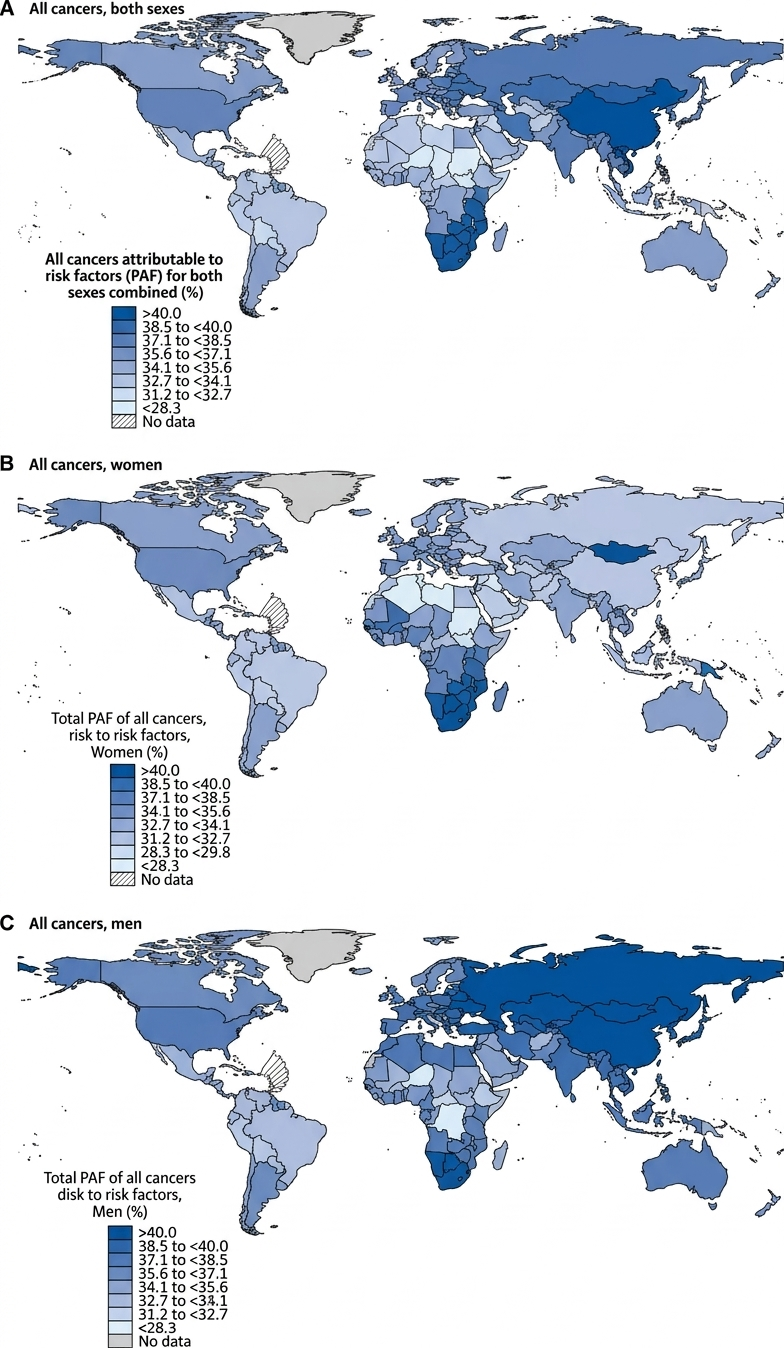
When consolidating data for both sexes, it emerged that 37.8% of the 18.7 million cases in 2022 were caused by modifiable risk factors. Notably, the proportion of preventable disease differed significantly by sex. For instance, this burden proved much higher in men, accounting for 45.4% (4.3 million cases) of 9.6 million total diagnoses. In the case of women, the corresponding figure was relatively lower, standing at 29.7% (2.7 million cases) out of 9.2 million diagnoses.
Globally, tobacco smoking remains the leading cancer risk, driving 15.1% (3.3 million) of new cases. It is followed by infections (10.2%) and alcohol consumption (3.2%). Notably, the highest potential for prevention was identified in lung cancer, where 1.8 million out of 2.5 million diagnoses were attributed to modifiable factors. These statistics confirm how changing behavioral factors and environmental conditions can radically transform global medical data.
Distinct Risk Profiles for Women and Men
The structure of risk factors differed sharply between women and men, pointing to the necessity for gender-adapted preventive measures.
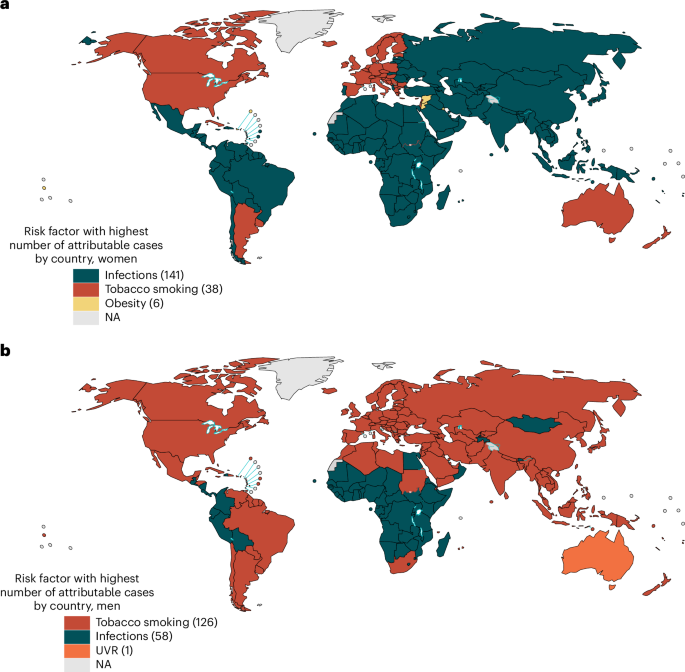
In women, infections were identified as the leading cause of cancer development, accounting for 11.5% of total cases. These data were largely based on cervical cancer statistics, as 91% of 662,004 cases were caused by HPV infection. Tobacco smoking, as the second most significant risk, underlay nearly half a million preventable cases of lung cancer (477,869). Of these, 60.5% were attributed to smoking, 27.5% to air pollution, and 12% to occupational factors. Additionally, in the risk structure for women, high Body Mass Index (BMI) dominated in 3.4% of cases. The impact of BMI was most evident in breast cancer cases (453,515), where 28.7% of the disease was linked to excess weight, 32.9% to physical inactivity, 20.5% to alcohol, and 17.9% to inadequate breastfeeding.
Among men, tobacco smoking emerged as the most aggressive risk factor (23.1%), leading to the development of over 1.3 million cases of lung cancer (1,326,453). The vast majority of these cases were linked to smoking (69.4%), air pollution (15.8%), and occupational exposure (14.7%). Infectious agents covered 9.1% of cases in men, dominating particularly in stomach (511,309 cases) and liver (461,985 cases) cancer statistics. In liver tumor cases, infections (53.1%) were joined by tobacco (21.3%), alcohol (19.5%), and excess weight (6%), indicating the complex nature of risks. Additionally, alcohol consumption accounted for another 4.6% of cases in men, reflected most significantly in the development of colorectal cancer (371,331 cases).
Regional Variations
The study showed an uneven distribution of cancer risks across 12 different global regions. Among women, the peak of preventable cases (38.2%) was recorded in Sub-Saharan Africa, contrasting sharply with the 24.6% mark in North Africa and Western Asia. In statistics for men, East Asia dominated (57.2%), nearly double the corresponding figure for Latin America and the Caribbean (28.1%), indicating varying regional prevention needs.
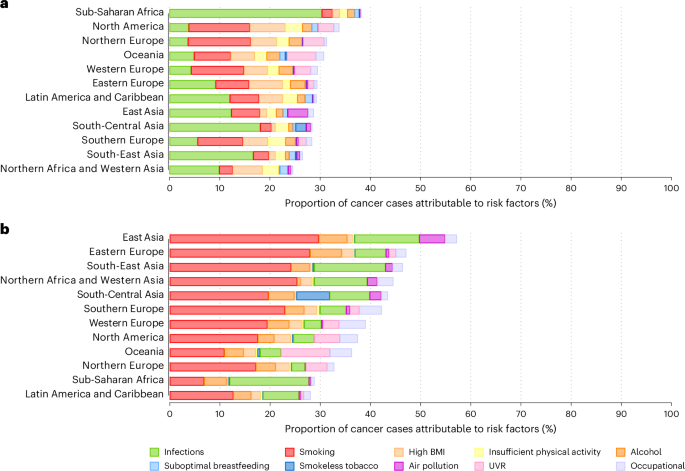
The causes of cancer in women directly reflected the region’s level of economic development. In low-income territories, including Sub-Saharan Africa (30.3%) and South Asia, infections remained the primary threat. Conversely, in high-income countries such as North America and Western Europe, tobacco consumption took first place. At the same time, the role of high Body Mass Index (BMI) was most evident in North America (7.1%) and Eastern Europe (6.7%).
In the case of men, the distribution of risks was more stable globally. Tobacco smoking exceeded the 20% mark in large parts of the Asian, European, and North African regions. Infectious agents maintained second place in East Asia (12.9%–14.2%), while in Eastern Europe, alcohol (6.3%) was named as one of the primary factors in cancer development.
Beyond global trends, the study also uncovered specific regional risks. In the Oceania region, 9.8% of oncological cases in men (skin melanoma) were linked to intense ultraviolet (UV) radiation. Meanwhile, in East Asia, 15% of lung cancer cases in women were attributed to high environmental and air pollution. These data clearly demonstrate how much a specific ecosystem impacts human health.
The Power of Prevention: Opportunities and Challenges
Tobacco remains the primary cause of preventable cancer. It causes nearly 60% of lung cancer cases in men and 15 other types of malignant tumors. Although the WHO MPOWER policy is successfully reducing consumption rates, these results do not immediately reflect in real incidence because tumor processes are characterized by slow development and a long latent period.
Infectious agents—nine primary types in total, including HPV, H. pylori, Hepatitis B/C, and Epstein-Barr virus—remain a serious problem in low-income regions. This trend is linked to weak sanitation systems and low access to immunization. However, the refinement of hygienic norms has already yielded positive results, reflected most notably in the decline of stomach cancer cases.
Parallel to this, high Body Mass Index (BMI) and low physical activity caused by changes in dietary rations pose a threat of breast and uterine cancer in women. The dynamics of alcohol consumption are gradually erasing the traditional statistical difference between women and men. The risk of air pollution also takes on a different character by sex: in men, this threat is attributed to the work environment, while in women, it is linked to household conditions. Such diverse threats require a complex and multi-sectoral approach.
Shaping the Future of Prevention-Oriented Medicine
The study, according to which 37.8% of cancer cases are based on modifiable risk factors, provides policymakers with orientations for action. Priorities include tobacco regulations, mass immunization, alcohol control, and air quality improvement. For women’s health, breastfeeding promotion programs play a special role. This approach serves to introduce transformative changes in oncological statistics.
Gender-sensitive strategies tailored to local contexts, including the WHO’s “best buys” and the strengthening of epidemiological surveillance systems, can halve new cases of the disease. The time for action is now, before the global burden of the disease increases even further.
Source: nature
