Over the last three decades, population aging, the obesity epidemic, unhealthy diets, and environmental pollution have established diabetes as one of the “top ten” global diseases. As of 2021, one in ten adults worldwide – a total of 537 million people – is living with diabetes. Notably, more than 75% of these patients reside in low- and middle-income countries, where healthcare resources are often limited.
Diagnostic deficiencies are particularly critical: nearly 45% of patients are unaware of their condition, allowing the disease to progress silently and uncontrollably. The situation was further exacerbated by the COVID-19 pandemic, which created a dual threat:
Diabetes significantly increases the risk of virus complications, hospitalization, and death.
COVID-19 itself acted as a trigger for the disease; studies confirm that patients who recovered from the virus have a 40% higher probability of developing Type 2 diabetes in the post-acute phase.
From Traditional Accounting to Complex Macroeconomic Analysis
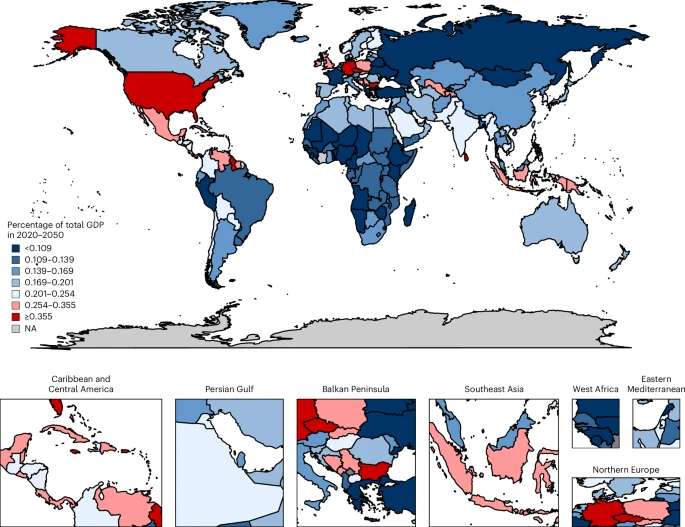
Early forecasts suggested the global economic burden of diabetes would reach $2.2 trillion by 2030 (approximately 2.2% of global GDP). However, these models were static and failed to reflect long-term dynamics, specifically how the disease hinders the accumulation of human and physical capital.
A new study covering 204 countries fundamentally changed the methodology. It examined the impact of diabetes on:labor force supply, savings dynamics and investments, and informal care (unpaid labor provided by family members).
Researchers compared a realistic forecast of global economic development against a hypothetical “diabetes-free” world. The difference between these two models represents the real “price” humanity pays:
Direct Economic Loss ($10.2 Trillion): Considering only treatment costs and reduced labor productivity, the world will lose $10.2 trillion between 2020 and 2050. This is equivalent to a 0.22% annual “hidden tax” on global GDP.
Loss Including Family Care ($78.8 Trillion): The picture changes dramatically when adding the time and energy family members spend on care. With this factor included, the loss increases nearly eightfold, reaching $78.8 trillion (1.72% of GDP).
Who Pays the Highest Price?
In absolute terms (2020–2050), the epicenter of economic loss will be the world’s largest economies. Including informal care costs:USA: $16.5 trillion; India: $11.4 trillion; China: $11.0 trillion
Per Capita: On an individual level, the heaviest burden falls on citizens of Ireland, Monaco, and Bermuda, where losses range from $8,000 to $18,000 per person.
Diabetes vs. Other Global Diseases
To grasp the scale of the impact, it is essential to compare it with other global pathologies (2020–2050 projections):
Alzheimer’s and Dementia: $14.5 trillion.
29 Types of Cancer (Combined): $25.2 trillion.
The comparison reveals that the direct economic damage of diabetes ($10.2 trillion) is almost half the total burden caused by all types of cancer. However, if informal care is included ($78.8 trillion), the loss from diabetes is three times higherthan the combined economic loss of both cancer and Alzheimer’s. This makes diabetes one of the most “expensive” and economically devastating chronic diseases in the world.
Prevention
Despite the alarming data, it is important to remember that 90% of Type 2 diabetes cases are preventable. This requires four fundamental factors:a healthy diet; Regular physical activity; Maintaining a Body Mass Index (BMI) within the normal range (< 25); Tobacco cessation.
The study identifies the following priority directions for state-level intervention:
Early Diagnosis: Activating pre-diabetes screening to stop progression at the initial stage.
Access to Therapy: Expanding access to modern and effective medications (e.g., GLP-1 receptor agonists).
Social Transformation: Ensuring financial and physical access to healthy food for all social strata.
Ultimately, investing in diabetes prevention is not just a humanitarian obligation but a central strategy for protecting global economic stability.
Source: nature medicine