


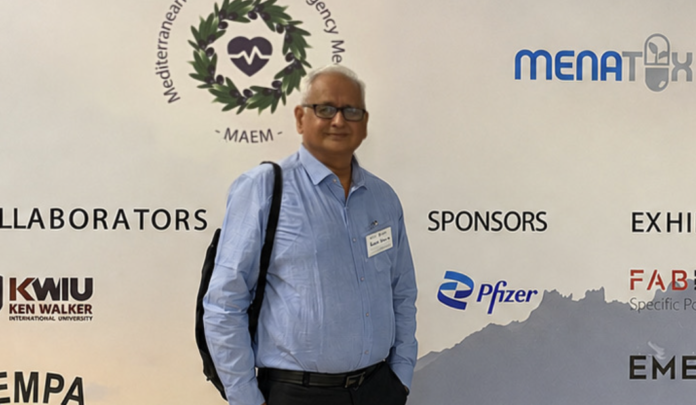
Thirty years ago, a phosphide fumigant used in grain silos across India carried case‑fatality rates that often approached nine out of ten patients in some series. Today, with better understanding of its pathophysiology and advances in intensive supportive care, those rates have fallen substantially in many centres – not because a miracle antidote appeared, but because clinicians spent decades refusing to accept ‘supportive care and hope’ as the limit of what medicine could do. Dr. Ashish Bhalla is one of those doctors, and metal phosphide poisoning – the subject of his session at this year’s Frontiers in Advanced Emergency Care and The Mediterranean Academy of Emergency Medicine Joint Congress in Tbilisi – is the poison that has occupied much of his career.
He came to Tbilisi, by his own account, for one simple reason: a twenty-five-year friendship with Dr. Ziad Kazzi. But underneath that friendship is something closer to a shared obsession – with the diseases that don’t announce themselves clearly, the poisonings hiding behind symptoms that look, at first glance, like nothing at all, and the discipline required to keep treating a patient long after most physicians would consider the case lost.
What made this invitation to Tbilisi worth accepting, and had Georgia ever crossed your mind professionally?
Ziad Kazzi – there’s only one name. He is a very good friend; we’ve known each other for more than 25 years. When he called to say he was organizing a meeting here, I said, “I’ll come.” I had heard a lot about Georgia and wanted to see firsthand what is happening here.
I also regularly attend MENATOX and MEMC meetings because they’re excellent learning opportunities. You learn from colleagues what is new and what is happening in the region. Often the problems discussed have already occurred in India or could occur there, so attending helps you anticipate and prepare.
Toxicology feels like a specialty within a specialty. In your case it grew out of internal medicine. What made you make toxicology the focus of your work rather than something you treat on the side?
My mentor. He was a professor of internal medicine at my institute and did extensive work on organophosphate and aluminium phosphide poisoning – two major problems for us. We wanted to define the pathophysiology and determine how to save people affected by these poisons. Over the last 30 years my mentor and I have documented and learned a great deal, especially about aluminium phosphide, which used to be highly fatal.
Aluminium phosphide once killed nearly 90% of those exposed. With advances in management we have reduced mortality to roughly 30-40%, which is a huge improvement. We have tried to define the mechanisms of injury and ways to prevent mortality, including changes in formulation. Colleagues such as Brent and Ziad challenged me to view the problem from different angles, which helped shape our work.
Also, emergency medicine and toxicology are profoundly rewarding. Many poisonings are self-harm in young, productive people. If you can save them, they often return to normal life. That possibility of restoring a life makes toxicology especially meaningful. The medical ethic “don’t give up until the patient is dead” also motivates persistent care in poisoning cases. Unlike many conditions where survivors may have long-term disability, many poisoned patients can fully recover if supported through the acute phase.
For a general audience: what common misunderstandings about poisoning should people be more cautious about? Even simple advice can make a difference.
One of the simplest pieces of advice for the general public is: never take any medication or home remedy without consulting a physician. Even common drugs such as paracetamol (Panadol) can be harmful if taken in unsafe doses or without knowing potential side effects. Don’t assume over‑the‑counter medicines are harmless – taking more than the therapeutic dose can cause serious problems.
Likewise, household chemicals are not benign when used improperly. Toilet cleaners, detergents and similar products are safe for their intended use, but ingesting or inhaling them can be dangerous. These are basic but important points for the public to understand.
If you suspect you’ve been exposed to a toxic substance – accidentally or by mistake – do not delay. Go to a hospital or contact your physician or a toxicologist. They can put you in touch with a poison centre and advise whether you need hospital care. Most exposures are not life‑threatening, but some are. Early clinical assessment helps determine who needs observation or treatment and can be lifesaving.
You’ve practiced for years; with the rise of social media and influencers promoting plant infusions and other unproven remedies, are you seeing more unintentional poisonings?
Yes – clearly. Too many young people follow social‑media advice without checking the speaker’s qualifications or verifying claims. I strongly advise against using treatments recommended online without consulting a physician. Before trying anything suggested on the internet, verify the information against reputable sources and, ideally, discuss it with a clinician or trusted colleague.
Remember: social media offers information, not knowledge. Information requires intelligent interpretation to become useful. For example, everyone knows a tomato is a fruit – that’s information. Knowing not to put it in ice cream because it does not belong there is the applied knowledge. Apply that same judgement to health claims.
Always verify claims two or three times before trying them. Common risky behaviours include using unproven topical remedies, “quick‑fix” weight‑loss teas or other shortcuts; these can be toxic and even fatal.
“Natural” does not automatically mean safe. Many natural products require specific processing before they are safe to eat – olives must be cured, coffee beans must be roasted – and dose matters: toxicity is dose‑dependent. Consuming anything in excess can cause harm.
Your presentation today is on metal phosphides. For readers unfamiliar with the term: what are metal phosphides and why should people care?
Metal phosphides – the most common are aluminium and zinc phosphide – are used worldwide as grain fumigants. When they contact moisture they release phosphine gas, which is highly toxic. Phosphine paralyses and kills rodents and insects, and it can also cause severe, even fatal, poisoning in humans.
The risk is often context dependent. In open air the gas dilutes and may pose less danger, but in enclosed spaces – for example, in a silo or storage room containing treated grain – inhalation can cause significant illness. Ingestion of a phosphide tablet or powder is particularly dangerous: phosphine is released in the body, rapidly absorbed, and produces cellular injury similar to cyanide. There are few specific antidotes, so treatment is mainly supportive.
These compounds are commonly kept for grain storage and pest control, and people sometimes transport them when they move between countries. That means the risk is not confined to one region: exposures can occur in many settings. Be vigilant for symptoms after possible exposure and seek medical attention promptly.
What are the warning signs and how quickly do they appear?
Symptoms can take time to develop. Inhalation may cause headache, dizziness, nausea, vomiting and hypotension. Low-level exposure may produce non-specific symptoms that seem like a minor illness, and patients may be sent home only to deteriorate later. If there is any possibility of phosphide exposure, tell your doctor so they can observe you longer; early disclosure can be lifesaving.
From an epidemiologic perspective, should clinicians be aware of geographic risk differences?
Yes. While metal phosphide poisoning is common in India, it’s also being reported across the Middle East and North Africa – large series have emerged from Egypt, for example. Clinicians everywhere should consider it if symptoms are unexplained. If you have unusual symptoms, seek medical advice; better to be evaluated than to ignore potential poisoning.
For severe poisonings without specific antidotes, what is the most important aspect of management?
Follow Airway, Breathing, Circulation (ABC). Maintain the airway, support ventilation, and sustain blood pressure. If you keep ventilation and perfusion adequate, organs can recover while the toxin is eliminated – often over 24-72 hours. Some toxins’ elimination can be enhanced pharmacologically; others require vasopressors or mechanical ventilation. A classic example is Indian common krait envenomation: the lungs are structurally normal but respiratory muscles are paralysed. Intubation and mechanical ventilation until the toxin wears off can save the patient. Never lose hope in a poisoned patient.
Vomiting and diarrhoea after poisoning are bodily mechanisms to expel toxins – they are survival responses. The real danger is dehydration and electrolyte imbalance resulting from these losses, not the vomiting per se. So supportive measures – fluids, electrolytes, respiratory support and vasopressors when needed – are essential.
As Georgia takes first steps toward specialized toxicology services, what lessons can the country borrow rather than reinventing the wheel?
You don’t need to reinvent the wheel. First, cultivate clinicians who are genuinely interested in toxicology – passion matters. Second, establish networks: poison information centres should be linked with treatment centres. Models vary: in the U.S. poison centres are stand-alone information services, while in the U.K. there are designated treatment units with dedicated critical care beds. Integrating poison information with emergency and critical care allows rapid triage and directed management.
If resources are limited, use existing assets: clinical pharmacology units can handle exposure calls, guide clinicians, and help triage patients. EDs and ICUs can allocate a few dedicated beds for poison treatment. If funding permits, develop dedicated poison centres and treatment units; if not, integrate services within existing departments and create clear referral pathways.
Will you remain involved with Georgia? Would you be open to collaboration?
Anytime. I’m happy to be involved. My wife and daughter are here now, and I told them I could come and work, teach and raise awareness. Ziad and groups like ACMT, MENATOX, and local leaders have done excellent work with webinars and training; I participate in many of those activities. If Georgia needs support, I’m a phone call away.
