


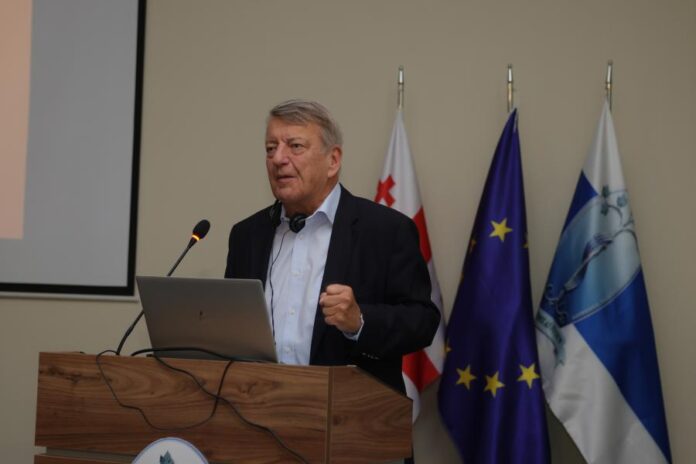
On November 14–15, Tbilisi State Medical University hosted the conference “Contemporary Issues in Emergency Medicine and Intensive Care.” Among the distinguished and honorary guests was Baron Jean-Louis Vincent, President of the World Federations of Critical Care, Emergency, and Intensive Care Medicine, as well as Shock and Sepsis. Professor Vincent is the author of internationally recognized guidelines and clinical protocols in these fields, whose implementation is currently being carried out on a global scale.
The conference addressed modern approaches to the management of acute cardiorespiratory failure and the updated recommendations for the management of severe infections and shock. It was Baron Vincent who presented the new guidelines for the management of sepsis and shock, during which he also discussed contemporary concepts in the care of critically ill patients, including fluid resuscitation strategies and emerging perspectives in critical care.
MedScriptum conducted an interview with Baron Jean-Louis Vincent, in which he discussed the importance of establishing rapid response teams, the prospects for the development of personalized medicine, and the growing role of artificial intelligence in contemporary clinical practice.
How does the establishment of rapid response teams in hospital wards help prevent the need for admission to the intensive care unit?
I believe that the establishment of a rapid response team (RRT) for the clinical management of critically ill patients is highly necessary. In such situations, the team assesses the patient and can promptly identify those whose condition has acutely deteriorated, providing timely assistance. This approach reduces the likelihood of patients requiring admission to the intensive care unit (ICU). Rapid response teams are essential because ward-based medical personnel often lack sufficient experience and expertise to manage critical situations independently. Therefore, they require support from specialists. Activation of the rapid response team should be possible for ward physicians via a phone call or a dedicated alert button. Upon activation, the team arrives promptly to assist the ward physician in patient management. In a more long-term perspective, this process could become fully automated with the support of artificial intelligence (AI). In this envisioned scenario, all patients’ vital signs would be continuously monitored and displayed on a centralized system. If a patient’s vital signs deteriorate sharply, AI would detect these changes and automatically trigger an alert, summoning the rapid response team without human intervention. This future-oriented approach has the potential to reduce response times, which are sometimes delayed due to human factors and the heavy workload of medical personnel. I believe that integrating AI in this manner could significantly improve patient outcomes and the efficiency of rapid response interventions.
What are the benefits of personalized medicine, and how can it be integrated into clinical practice while maintaining safety and adherence to established protocols?
I do not support overly protocolized medicine. This approach is very much an American concept, arising from a shortage of specialized physicians and the need for nurses to manage and execute most clinical tasks. As a result, everything has to be standardized through protocols. Of course, every country and healthcare institution uses protocols for simple and easily standardized clinical situations, but for complex conditions, such as sepsis management or respiratory distress, it is impossible to create a single “ideal” protocol that fits every patient. The management of such complex conditions must be individualized, which is where personalized medicine becomes essential. Every patient has a unique history and clinical presentation, requiring physicians to develop an individualized therapeutic plan. In the future, artificial intelligence may assist in this individualization, helping clinicians tailor treatments more precisely to each patient’s needs. Gradually, we are moving in the direction of personalized medicine rather than one-size-fits-all, protocol-driven approaches.
In recent years, which protocol or paradigm shift in medical practice has been the most significant, having a major impact on acute care and intensive care medicine?
This reflects a shift back toward personalized medicine, which we are gradually returning to. Personalized approaches have always existed, but a few years ago, there was a strong emphasis on protocolized care, everything was placed into a rigid framework, implemented without artificial intelligence. Today, this system no longer works. Consequently, current emphasis is on individualized treatment, as every symptomatic patient is distinct. For example, sepsis is highly heterogeneous. Multiple underlying pathologies can coexist and contribute to the development of sepsis, and management must consider each contributing factor. In such cases, we are returning to personalized medicine. A practical example of patient-tailored care is fluid resuscitation. Administering fluids does not simply mean giving 1–2 liters and stopping. That approach is insufficient: for some patients, 2 liters may cause fluid overload, while for others, more than 2 liters may be necessary to achieve adequate resuscitation. These variations illustrate why strict adherence to formulas or rigid protocols is both impossible and inappropriate such approaches simply do not work.
What role does the integration of artificial intelligence and telemedicine play in the daily practice of medicine?
Artificial intelligence (AI) and telemedicine accelerate virtually all aspects of healthcare delivery, making their use a significant time-saver in the technological era. These systems can be rapidly integrated across multiple medical specialties. Although implementation involves substantial upfront costs, they also generate savings by reducing the need for prolonged hospital stays. AI and telemedicine can shorten inpatient duration, allowing patients to receive timely and effective treatment before being discharged home. This offers major benefits for healthcare facilities, as prolonged hospitalization is often associated with complex medical conditions, which are costly to manage. The adoption of these technologies is relevant for high-, middle-, and low-income countries alike. While hospitals must invest heavily in technology, these systems can reduce direct expenditures on medical personnel. Therefore, they are likely to decrease overall healthcare costs globally and represent a sound long-term investment. Furthermore, AI supports clinicians in making timely decisions, particularly in the management of critically ill patients, enhancing both efficiency and patient outcomes.
How can invasiveness be minimized in the intensive care unit, and what are the most important recent advances that facilitate less‑invasive management of critically ill patients?
It is unfortunate that completely eliminating invasive methods is not feasible, given the complexity of managing critically ill patients. However, contemporary medicine offers less-invasive approaches, such as extracorporeal membrane oxygenation (ECMO). ECMO can help avoid endotracheal intubation in patients with respiratory failure. This technique is considered minimally invasive and organ-protective, as its use may allow patients to avoid pharmacologic sedation.
In your opinion, what are the most pressing unresolved issues in critical care medicine today that require further research?
A current challenge in critical care medicine is identifying more effective and targeted therapeutic interventions based on the patient’s underlying pathophysiological processes. For example, if a pathology is driven by an excessive inflammatory response, research into anti-inflammatory strategies and the selection of appropriate therapeutic approaches may be warranted. Conversely, in cases where patients exhibit acquired immunosuppression, stimulation of the immune system and the application of suitable immunomodulatory strategies become necessary. Developing such differentiated strategies requires deeper and larger-scale studies to establish a solid scientific foundation for therapy. Accordingly, in modern medicine, particularly in critical care, intensive research is a key prerequisite for clinical progress and the advancement of more personalized treatment approaches.
Source:
