


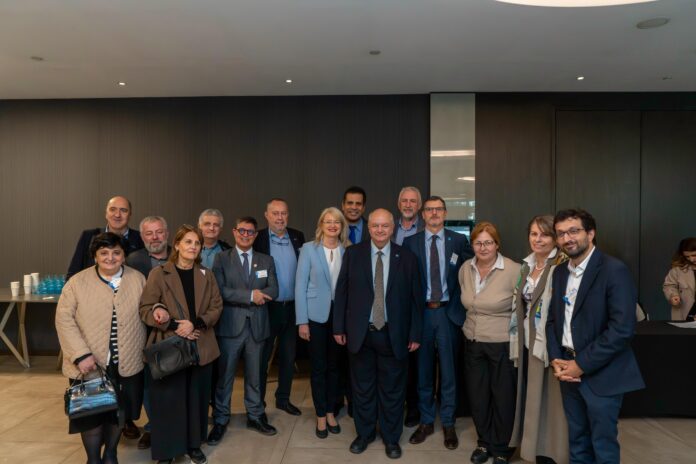
The European Union of Medical Specialists (UEMS) is one of Europe’s most authoritative professional organizations, bringing together experienced professionals from different countries and setting common standards for medical education and clinical practice across the continent.
In 2024, the Georgian Association of Medical Specialists (GAMS) officially became an associate member of this influential organization. In October, Tbilisi hosted the UEMS Autumn Meeting for the first time.
We spoke with Dr. Giorgi Chakhava, neurologist, Associate Professor at David Tvildiani Medical University, and President of the Georgian Association of Medical Specialists (GAMS), about this historic event and the significance of cooperation with UEMS.
Dr. Giorgi, last year Georgia became an associate member of UEMS, and this year Tbilisi hosted its annual meeting. How difficult was the journey to this point, and what does it mean for the country?
Giorgi Chakhava: Indeed, in 2024, Georgia officially became an associate member of UEMS, which is the highest possible status for a country that is not a full member of the European Union. Moreover, during last year’s assembly in Brussels, by a vote of 20 to 6, it was decided that the next annual meeting would be held in Tbilisi.
This is a great sign of trust and respect toward our country’s medical community. It follows a long and challenging 20-year journey. Our path began slowly, with small steps back in 2008, when the first memorandum between GAMS-Georgia and UEMS was signed.
Our first experience came in 2011, when, in collaboration with Tbilisi State Medical University and with the support of SIDA, we organized the international conference “European Medical Education and Implementation Pathways in Georgia.” The event was attended by leading European organizations such as UEMS (represented by Secretary General Bernard Maillet), the European CME Forum (Eugene Pozdniakov, President), the European Medical Association (EMA) (President Ted Popov, also President of the Bulgarian Medical Association), Janet Grant, Director of the Open University and renowned expert, and Galina Perfilieva, representative of the World Federation for Medical Education (WFME) in Eastern Europe, I also had the poosibiity to make the presentation on behalf of the Georgian Association of Medical Specialties. Subsequently, Janet Grant held masterclasses on Postgraduate Medical Education.
Much time has passed since then — back then, I headed the Strategic Development Department at Tbilisi State Medical University; now I am an Associate Professor at David Tvildiani University. However, the topic of Postgraduate Continuous Medical Education still unites us all.
Thanks to our efforts, UEMS has become an active player in the entire region. Through this collaboration, we have gained unique experience in curriculum development, question generation, and European-level examinations. Today, two major UEMS sections — Urology and Public Health — have secretaries from Georgia.
The UEMS Tbilisi meeting was truly unprecedented, as it was the first international medical forum of such scale ever held in Georgia. It became not only a professional but also a cultural dialogue platform.
How did the meeting go, and which topics were most important for discussion?
The meeting was very engaging. Delegates from various European countries discussed several key topics. Active working groups included those on postgraduate (residency) education, continuous medical education (CME) and professional development, and artificial intelligence.
An important discussion also took place on medical challenges related to the war in Ukraine, particularly how to support doctors and maintain medical standards under wartime conditions. Each of these themes requires its own framework, syllabus, and curriculum.
Therapeutic, surgical, and mixed-specialty groups — which include laboratory medicine, radiology, and public health — also discussed pressing issues. Ultimately, all proposals developed within these thematic federations and multidisciplinary sections are submitted to the Advisory Council, where final decisions are made by majority vote.
One of the central themes was the harmonization of residency programs across Europe, to ensure uniform quality of specialist training throughout the continent. Another major focus was the role of artificial intelligence in medicine, including its use in diagnostics, research, and clinical decision-making.
These discussions are especially significant for Georgia, as aligning our medical education system with European standards is a crucial national priority.
How did guests receive Tbilisi and evaluate Georgian hospitality?
Very positively. Participants praised not only the organizational level but also the warm and sincere atmosphere that Tbilisi is known for.
What long-term benefits will Georgia gain from its partnership with UEMS?
In the long term, this partnership means that Georgian doctors will have access to European-level educational and certification opportunities.
Additionally, participation in UEMS structures allows us to contribute to European discussions on education, ethics, and clinical practice. Although we do not yet have voting rights, our opinions are heard and respected. This collaboration integrates Georgia’s medical field as a full participant in the European medical space.
What are GAMS’s plans for the near future?
We plan to be active in several directions. Aligning medical education with European standards requires close cooperation, involving young doctors, and creating practical training bases.
For this, it is essential to implement the European Training Requirements (ETR) and Entrustable Professional Activities (EPA) systems. The EPA framework assesses how independently a doctor can perform specific medical procedures.
For example:
There are several levels of evaluation: fully independent, partially independent, and under supervision. Each level is assessed by specific criteria.
Our ultimate goal is to establish accredited training centers in Georgia that will prepare modern, independent specialists who meet international standards.
This is both a mission and a laboratory for training future physicians. All our efforts must be directed toward this.
How can UEMS contribute to this process?
UEMS plays a vital role in this process because it unites medical specialties, sets standards, and can establish working groups with specific countries or specialties. Such groups may include national representatives, professional associations, and stakeholders (universities, clinics, and even the business sector).
This is a complex but promising path, and we are open to cooperation in every direction. What message would you like to send to young doctors and students who are just beginning their professional journey?
First of all, I want to tell them that the European door is now open for them. If they are hardworking, motivated, and professional, Georgian doctors can be fully competitive in the European market.
Our mission is to create the right conditions and provide all opportunities for education and professional development.
Conclusion
Georgia’s accession to the European Union of Medical Specialists (UEMS) is not only a professional milestone but also a major step toward aligning the country’s medical system with European standards.
The efforts of Dr. Giorgi Chakhava and the GAMS team reaffirm that Georgian medicine is ready to become a full member of the international scientific and clinical community.
