


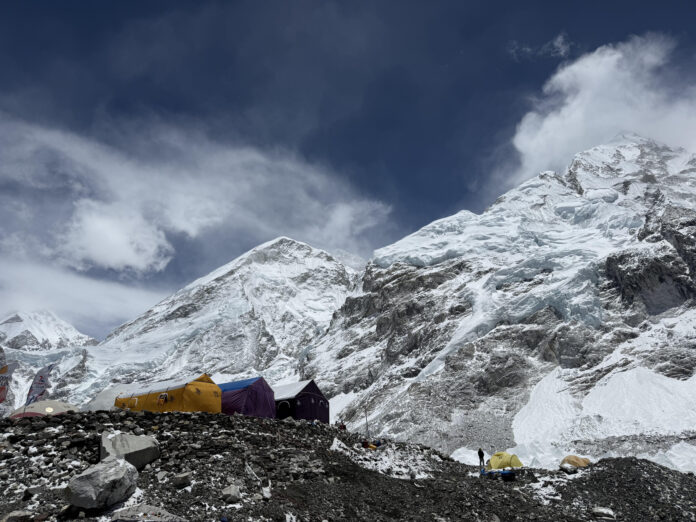
On May 14, a medical team consisting of two Georgian doctors reached the Everest Base Camp and raised the Georgian flag there. I was one of these two people, and here, beneath Everest, in the Himalayan ranges high above the clouds—where the air thins out several thousand meters above sea level and medicine acquires a completely different meaning—I had the opportunity to personally familiarize myself with completely different aspects of extreme medicine and exchange experiences with local doctors of the “Everest Way.”
In the Khumbu region of Nepal, in a small clinic in Gorakshep, doctors fight daily not only against illnesses but against the environment itself: the cold, lack of oxygen, isolation, and a deficit of resources. Here, on the way to Everest, even a seemingly minor headache can mark the beginning of a life-threatening condition. Medscriptum had the opportunity to visit the world’s highest clinic in Gorakshep (5,100 meters above sea level) and interview the local doctors.
The first thing that catches your eye upon entering the clinic at this altitude is the specific medical equipment: rows of oxygen cylinders and small, compact hyperbaric chambers (Gamow bags). These items are not a luxury here; they represent the only guarantee of life for patients on the critical brink.
What is the most common complaint with which patients present to the clinic?
“These are the symptoms of altitude sickness, which everyone complains about in their own way—be it dizziness, nausea, general weakness, or difficulty breathing. But among these, the most difficult and significant are still cerebral and pulmonary edema, the treatment of which requires special attention and effort.
In reality, in most cases, the treatment consists of several components: administering dexamethasone, administering acetazolamide (also known as Diamox) for further prevention, and, if necessary, placing the patient in a hyperbaric chamber. However, in the majority of presentations, medication treatment and adding an extra day to the journey for better acclimatization yield the best results.”
“Trauma is also common among travelers, such as sprained ligaments, fractures, or various types of contusions. Depending on our capabilities, we treat both altitude sickness and traumatic cases either locally or prepare the patients for helicopter evacuation to continue treatment relatively lower below sea level, in a clinic with more resources.”
To discuss this in more detail, we must remember that Acute Mountain Sickness (AMS) is caused by a drop in atmospheric pressure, due to which oxygen molecules are further apart from each other. At this time, the body experiences acute hypoxia.
The two critical conditions mentioned by the doctor are HAPE and HACE:
-
HAPE (High-Altitude Pulmonary Edema): In response to hypoxia, the pulmonary arteries constrict sharply, pressure increases, and fluid shifts from the blood vessels into the alveoli. This causes a sensation of suffocation and cyanosis (blueness of the skin).
-
HACE (High-Altitude Cerebral Edema): Due to the lack of oxygen, cerebral blood vessels dilate, intracranial pressure increases, and edema develops. Its main sign is ataxia (loss of coordination, walking like a drunk person).
The drug dexamethasone, which is probably unfamiliar to no one, is one of the primary medications for treating these conditions because it is a potent steroid that suppresses inflammatory processes and rapidly reduces brain swelling. Acetazolamide (Diamox) “acidifies” the blood through the kidneys, which forces the brain to signal the lungs for more frequent and deeper breathing (hyperventilation), thereby regulating the blood pH level and stabilizing oxygen levels at night. The small hyperbaric chambers in the clinic (so-called Gamow Bags) are airtight bags where pressure is increased using a foot pump, which mechanically creates the effect of descending 300-500 meters lower for the patient’s body.
We have heard from many travelers that intoxication is one of the most common things they fight on the way to Everest. What is the presentation rate in this regard?
“In reality, cases of food poisoning and presentations because of it are probably the least of what we have to deal with. It is essential not to confuse altitude sickness with food poisoning, as they often present with the same symptoms. Often, the local food is difficult for foreigners to digest, which manifests as a bloated stomach, and people call all of this food intoxication, which is incorrect. And still, if it comes down to food poisoning, the cause is mainly mushrooms, which they consume in the villages passed along the way.”
The phenomenon that hypoxia affects the gastrointestinal tract is well known in high-altitude medicine. During oxygen deficiency, the body centralizes blood circulation—blood is preferentially supplied to the brain and heart, while the digestive system “starves.” Peristalsis (intestinal movement) slows down, causing gas accumulation, spasms, nausea, and bloating. Added to this is the high-carbohydrate diet characteristic of the Himalayan region (for example, the traditional “Dal Bhat”). Travelers often mistakenly attribute these symptoms to bacterial intoxication, whereas it is simply a clinical manifestation of the body’s adaptation to altitude.
In what case might you make the decision that a patient’s evacuation by helicopter is necessary?
“The main indicators for this are still acute pulmonary or cerebral edema, or an alarmingly low oxygen level. All of this is mostly closely linked to each other and in direct correlation with the patient’s overall picture. Even when local oxygenation (oxygen supply) and medication treatment are ineffective, we request their urgent transfer down, 500 or more meters below sea level, where reversing their condition is possible much faster. If the symptoms are relatively mild, as I already mentioned, staying on-site for acclimatization is sufficient. Generally, it takes 12 hours for symptoms to resolve in such cases, but we issue a recommendation to stay in the village for 1-2 days before they continue any kind of travel.”
According to international protocols, the gold standard for treating HAPE and HACE is immediate evacuation. While many diseases in the lowlands can be managed with bed rest, dropping physical altitude in a hypoxic environment is the only pathogenetic treatment (eliminating the cause). Descending even 500-1000 meters below sea level increases atmospheric pressure, which momentarily increases arterial saturation and relieves the critical load on the lungs and brain.
It was very strange for both me and my colleague when, on the 5th day of our expedition, at 4400 meters above sea level, we obtained a result of 83-84% while measuring oxygen saturation, even though we felt excellent. We shared this observation with the local doctors and asked for their opinion.
The Importance of Oxygen Levels
“A saturation of 83% for a traveler at this altitude is an excellent figure! According to our observations, the norm here equals 70; we monitor data lower than that with relatively more attention. In the recent past, we had a patient whose saturation equaled 35%; despite all this, he was still conscious and communicative. Of course, we carry out active intervention with such patients and, after stabilization, issue a recommendation for urgent evacuation.”
Under normal conditions (at sea level), a reading below 90% on a pulse oximeter is a sign of respiratory failure, while 35% is a fatal figure. However, in the high mountains, the so-called oxyhemoglobin dissociation curve works. In the process of adaptation, the body increases the production of 2,3-diphosphoglycerate (2,3-DPG), which helps hemoglobin “release” oxygen to tissues more easily. Therefore, even under low saturation conditions, tissues manage to maintain minimal functioning. The phenomenon where a patient has an alarmingly low saturation but subjectively does not feel shortness of breath or loss of consciousness is called “Happy Hypoxia” in clinical medicine.
What is the main cause of altitude sickness?
“This is clearly a lack of acclimatization. A person living by the sea cannot suddenly decide to ascend to 5,000 meters above sea level and do this in a few days, especially when you start the journey from the town of Lukla directly at 2,500 meters. It is necessary to rest for a few days along the way and only then continue it. This gives the already stressed body an opportunity to rest, gather strength, and adapt. If a traveler does not respect the mountain, it will definitely punish them.”
Another common condition that many travelers talk about is the Khumbu cough. What is this, and how do you treat it?
“The Khumbu cough is nothing other than a throat severely dried out by dry and cold air, which large particles of dust scattered in the air then easily irritate. Because of this, patients often complain of a dry, severe cough characterized by long-term attacks that resolve with difficulty. We treat such a condition with cetirizine, salbutamol, or Xanax. In reality, the mentioned cough sounds more dangerous than it actually is due to its characteristic sound; therefore, it does not pose a threat to health and, sooner or later, clears up on its own even without treatment.”
The Khumbu Cough is known in medical language as high-altitude bronchitis. At 5,000 meters, the temperature is often below freezing, while humidity approaches zero. During physical exertion, travelers begin intense mouth breathing (hyperventilation). Cold and dry air directly hits the trachea and bronchi, which causes drying and microtrauma of epithelial cells. At this time, cetirizine (an antihistamine) reduces the reactivity and secretion of the upper respiratory tract; salbutamol (an inhaler) relaxes the smooth muscles of the bronchi, which relieves the spasmodic cough. Xanax (alprazolam), despite being an anxiolytic, is used in small doses at night to suppress the central cough reflex (by acting on the central nervous system) so that the patient can have a peaceful sleep.
What is the main challenge for local doctors and the clinic?
“This is probably the scarcity of resources. Due to the isolated location, it is difficult to constantly replenish supplies unless, of course, a helicopter does it. Otherwise, the biggest problem is the shortage of electricity. Here, at 5,100 meters above sea level, electricity transmission lines do not exist; consequently, we are completely dependent on solar panels, which creates a lot of problems during bad weather and nighttime hours. This, of course, is reflected in the well-being of the patients.”
In reality, wrestling with extreme conditions high above the clouds and walking this path worthily sparks a small sense of satisfaction in a person. But when you see doctors who, even here on the mountain peaks, are engaged in saving human lives and show you that medicine does not work the same everywhere, you realize what a proud profession you represent, and at the same time, how small you are before the grand universe that continues to exist around us.
