


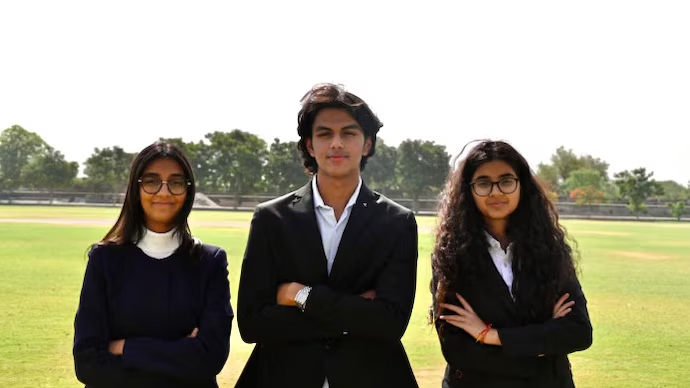
The environmental crisis and water pollution represent one of the most pressing challenges of modern times, often requiring billion-dollar budgets and complex technologies to address. However, three Indian teenagers have proven that ingenious solutions can sometimes hide in the most ordinary objects around us. 16-year-olds Aviana Mehta, Vivaan Chhavchharia, and Ariana Agarwal developed an innovative project called “Plas-Stick.” For this breakthrough, they secured the grand prize at “The Earth Prize 2026,” the world’s largest environmental competition for youth, becoming the first-ever team from India to achieve this global recognition.
The idea was born when the teenagers visited a rural village in India and noticed a child drinking water from a communal plastic container. In these communities, people lack access to modern water filtration systems and often have no idea that they are consuming toxic microplastics, which are invisible to the naked eye. Microplastics, consisting of particles smaller than five millimeters, pose a serious threat to human health, as scientists are already detecting them in human blood, lungs, and other organs. The teenagers set out to create a method that would be inexpensive, accessible to everyone, and require no electricity or complex infrastructure.
They found the solution in a plant widely used in South Asian cuisine: tamarind. The students discovered that discarded tamarind seeds, which are largely considered agricultural waste, possess natural binding properties. They created a biodegradable magnetic powder that, when added to water, attracts microplastic particles and clusters them into visible clumps. After this, removing the plastic waste from the water is easily achievable using a simple handheld magnet. Researchers from the Indian Institute of Technology (IIT Guwahati) assisted the youth in perfecting the project.
As part of the competition, where thousands of people voted alongside the expert jury, “Plas-Stick” first won the regional stage for Asia and was subsequently crowned the global champion at the awards ceremony held in Geneva. Along with the recognition, the team received significant financial support, which they will use to scale up the project. To date, they have already conducted numerous educational workshops, and their methodology has been adopted by more than 8,000 students and teachers. With the grant received, the young inventors plan to set up decentralized manufacturing hubs and aim to provide clean water access to tens of thousands of people living in rural India by the end of the year.
Notably, the “Plas-Stick” approach goes beyond a mere laboratory discovery and aims to develop a circular economy. Tamarind seeds, which previously ended up in landfills, now turn into valuable raw materials, creating an additional source of income for local farmers. Furthermore, the financial model of the project is structured so that the production of the powder involves minimal costs, making it commercially viable even for the most disadvantaged regions. In doing so, the youth have addressed several important United Nations Sustainable Development Goals, including access to clean water and sanitation.
Such success on the global environmental stage is a clear signal that leadership in the environmental movement is passing to the new generation. The jury of “The Earth Prize” particularly highlighted the scalability of the project—the fact that the technology can easily be adapted to any part of the world facing microplastic pollution where local natural resources can be utilized. Aviana, Vivaan, and Ariana have proven that age is no barrier to initiating global change, and the small magnetic powder they created may well become a guardian of life and health for millions of people in the near future.
