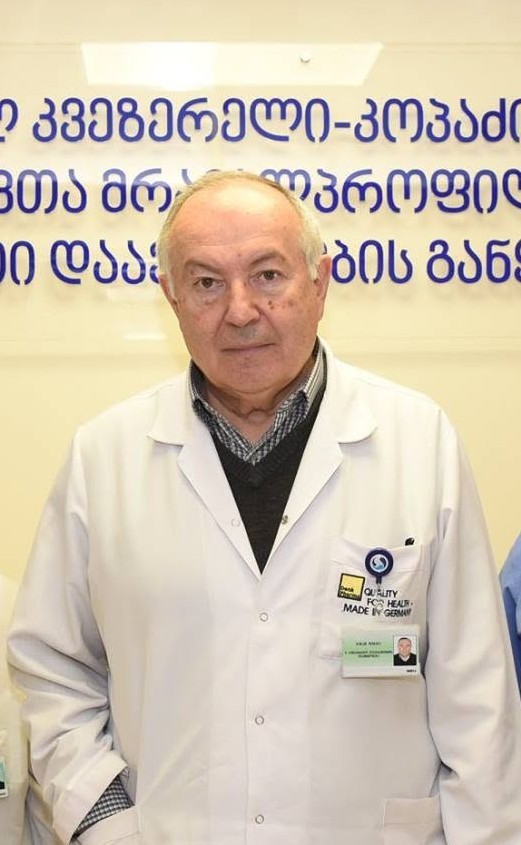
Guram Chitaia, a pediatric nephrologist, pediatrician, Doctor of Medical Sciences, and Professor at the I. Tsitsishvili Children’s Clinic, turned 80.
His decades of service are closely linked to the development of pediatric nephrology, patient care, and the training of young colleagues.
On the occasion of his anniversary, Mr. Guram spoke to us about his past years, his mentors, the evolution of the field, and the core principles of medical practice.
Mr. Guram, how did your path in medicine begin, and what determined this choice?
I didn’t choose medicine myself; it happened a long time ago on my mother’s advice. My mother was also a doctor. Pediatrics, on the other hand, was my own choice, though I had no particular reason for it. I have worked with both adults and children. Currently, I practice exclusively in my main specialty — as a pediatric nephrologist. Looking back, my experience has reinforced my belief that this decision was right. Interacting with children, at any age, is rewarding. Had I started working with adults, I would probably feel the same as I do now, I don’t know.
Looking back at your long practice, which stage was pivotal and most engaging for you as a professional?
For me, that stage was my postgraduate residency years. The supervisor of my dissertation was Ms. Meri Gelovani, the first pediatric nephrologist and founder of pediatric nephrology in Georgia. I worked with her, and it was under her guidance that I formed as a pediatric nephrologist.
Later, working on my doctoral dissertation was also a very important period. Overall, every day and every interaction with patients is special. It is a highly responsible and interesting process; each patient is an individual, and their illness is evaluated accordingly on an individual basis.
Who were your main mentors, from whom you learned your approach to the profession?
My first mentor was Professor Irakli Tsitsishvili, who was then the head of the pediatrics department. Also, Docent of that period, Ms. Leli Kerkadze, who later became a professor and head of the department.
And, of course, Professor Meri Gelovani — she succeeded her teacher, Mr. Irakli Tsitsishvili, as head of the department. She remained our mentor throughout her life.
How has pediatric nephrology and patient care approaches changed over the course of your professional career?
The changes are immense. Even in terms of diagnostics — take kidney biopsy, or the management of conditions with a chronic course. Today, it is already possible to treat these chronic patients with replacement therapy.
Furthermore, congenital anomalies are now diagnosed during the prenatal period, allowing us to intervene early and correct the condition. All these are advancements that simply did not exist before.
Of course, approaches have also evolved — today we have guidelines that direct us on how to approach each patient. Moreover, there are colleagues with whom we can always discuss cases.
Is there a particular patient or case that stands out in your memory?
Years ago, a girl was brought from Samegrelo with a months-long history of illness. Kidney failure developed very rapidly. About a year later, she underwent a kidney transplant — her mother was the donor, who, unfortunately, later passed away.
And just about a month ago, this beautiful girl came to the clinic with her wonderful fiancé and invited me and my colleague to her wedding. I was overjoyed to see her so beautiful and happy.
What is your main professional principle or value?
A doctor’s primary principle is still to do no harm to the patient — neither through an incorrect diagnosis nor through improper treatment. Ensuring this requires the ability to listen to and value others’ opinions.
It is in this spirit that we train future nephrologists and physicians who study with us in the pediatric nephrology residency program, which I lead. I believe this approach is always right — there is nothing extraordinary about it.
I developed this habit from Ms. Meri — she would always consult with us, and every patient’s diagnosis was a matter of thorough discussion. This tradition continues within our group of nephrologists to this day. As I mentioned, our primary teacher was Ms. Meri Gelovani, which is why we established this tradition — we have a special day when we gather, meet, and remember Ms. Meri.
What advice would you give to young colleagues who are just starting out on this challenging and responsible path?
First and foremost, they should think carefully about which specialty they want to choose. And once the choice is made, they must be prepared for immense hard work to fully master that specialty.