


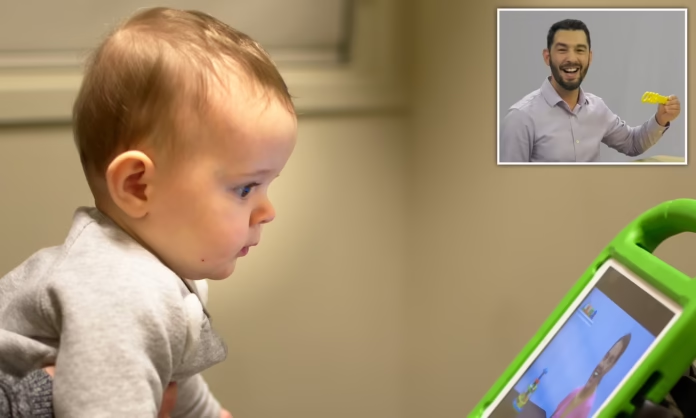
It should be noted that the early diagnosis of autism is one of the most significant challenges in modern medicine. In recent years, scientific circles have paid special attention to eye-tracking technology, which allows specialists to identify developmental disorders in children much earlier than was possible through traditional observation methods.
Principle of Operation and Biomarkers
The principle of the technology’s operation is based on high-frequency infrared sensors and specialized cameras that record pupil movement and gaze focus several hundred times per second. When a child looks at social scenes presented on a screen—such as a dialogue between people or a play process—the system accurately measures the direction of the gaze, the duration of pauses, and the points of fixation.
The main scientific assumption is that children with neurotypical development instinctively seek “social information,” such as eye contact and facial expressions. In children with autism spectrum disorder, the gaze trajectory is often different: they focus on geometric figures, details of objects, or the mouth movements of a speaking person instead of the eyes. The algorithm processes this data and creates a so-called “heatmap,” which clearly shows the patterns of visual attention distribution.
Leading Centers and Innovations
The Marcus Autism Center at Emory University in the United States is considered a global leader in this field. The technology they developed, EarliPoint Evaluation, became the first FDA-authorized device to be used in clinical practice. Significant research is also being conducted by the Yale University Child Study Center and the University of California (UC Davis MIND Institute), which are working on refining algorithms to make diagnostics even more accurate for children from different ethnic and cultural groups.
Accessibility and Future Perspective
Although the technology is revolutionary, its widespread accessibility remains a challenge. At this stage, the systems are mainly available in high-tech clinics and university hospitals. However, work is underway on mobile applications that will use smartphone cameras for eye tracking, which in the future will allow pediatricians to conduct primary screenings even during a regular consultation.
Specialists emphasize that the earlier a disorder is identified, the more effective the therapeutic intervention will be, which will help the child better develop social skills in the future. Eye tracking represents a powerful supportive tool in the clinical evaluation process, and scientists hope it will soon become an integral part of pediatric practice worldwide.
source:
