


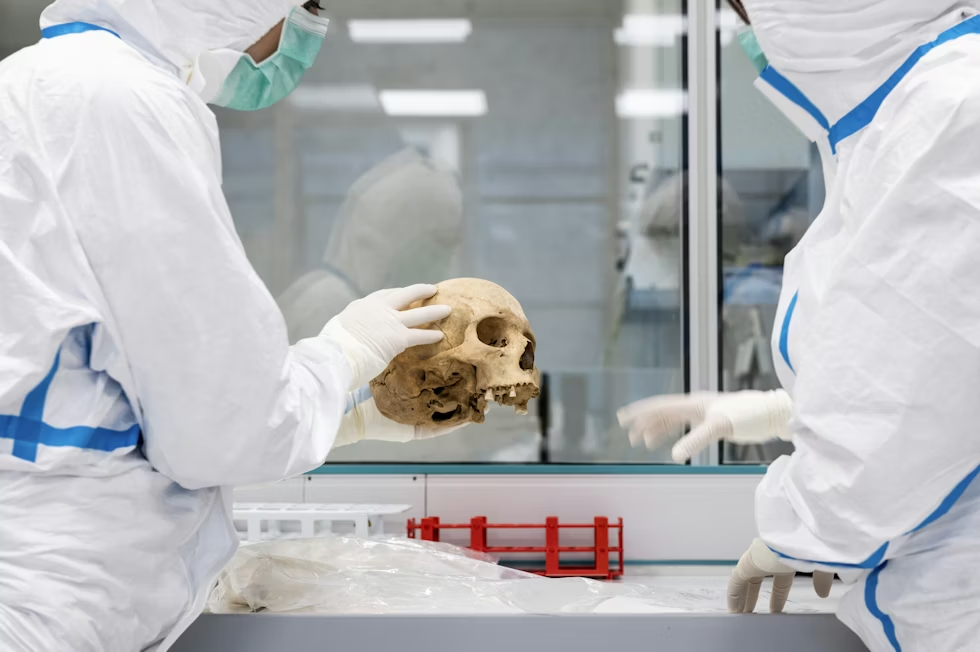
A recent study based on ancient DNA analysis has solved a major archaeological mystery. The burial of a mother and child from the Late Glacial period, discovered in southern Italy, represents the earliest genetic diagnosis in human history regarding a rare growth disorder. Scientists identified a mutation in a bone-growth gene, explaining the remains’ unusual anatomical features and proving that rare genetic diseases existed even in deep prehistory.
The research was conducted by an international team led by the University of Vienna and the Liège University Hospital, in collaboration with the Italian and Portuguese governments. Published in the New England Journal of Medicine, the study integrates paleogenomics, clinical genetics, and anthropology.
What the DNA Analysis Revealed
Scientists extracted DNA from the petrous bone, known for its excellent preservation of genetic material. Sequencing showed that:
-
Both individuals were genetically female.
-
They were close relatives—likely mother and daughter.
-
The younger individual had two mutated copies of the NPR2 gene.
-
The mother had only one mutated copy.
-
The diagnosis for the younger individual is Acromesomelic Dysplasia (Maroteaux type).
How the NPR2 Gene Affects Bone Growth
Under normal conditions, CNP (C-type Natriuretic Peptide) binds to the NPR2 receptor on the growth plate (the cartilaginous surface of the bone). This activates the production of cGMP, which stimulates the proliferation and differentiation of chondrocytes. As a result, long bones grow in length.
If a mutation occurs in the $NPR2$ gene that causes loss of function, the receptor fails to respond to CNP. Consequently, $cGMP$ is not produced, and cartilage cells cannot complete the growth process, leading to significantly shortened limbs.
What is Acromesomelic Dysplasia?
This is a rare autosomal recessive skeletal dysplasia that occurs when an individual has two mutated copies of the $NPR2$ gene (biallelic mutation).
Characteristics include:
-
Severely short stature.
-
Disproportionately short limbs (especially forearms and lower legs).
-
Short hands and feet.
-
Normal intelligence.
-
Specific radiological changes.
Heterozygous carriers (with one mutated copy) may have mildly short stature but do not develop the full syndrome.
Significance for Modern Genetics
-
Historical Expansion of Diagnosis: This is the earliest genetic diagnosis in history, proving that modern genomic methods can be successfully applied to ancient samples.
-
Evolutionary Perspective: It shows that rare genetic diseases existed millennia ago and mutations could persist in small populations.
-
Clinical Value: Better understanding of $NPR2$ mutations helps in diagnosing rare growth disorders and developing molecular therapies, including research into growth hormone efficacy for patients with $NPR2$-associated short stature.
Social and Anthropological Impact
The fact that the younger individual reached adolescence despite a severe growth disorder suggests that social care and support existed in prehistoric societies. This provides vital insight into human empathy and social structures during the Ice Age.
source: sciencedaily
