


The nursing profession is the backbone of the healthcare system, encompassing direct patient care, monitoring, and emotional support. Nurses often spend more time with patients than doctors do, playing a decisive role in their recovery. Despite this vital importance, nursing in Georgia faces severe challenges, primarily characterized by inadequate financial compensation and grueling, often 24-hour shifts.
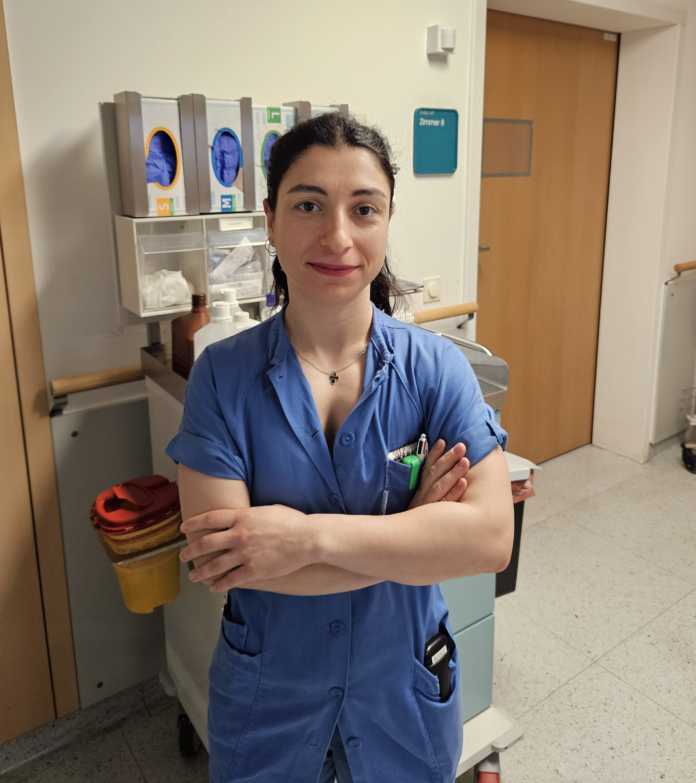
What distinguishes the nursing profession in Georgia from Western standards, and why is Europe becoming the primary center of attraction for Georgian medical personnel? We discussed these and other pressing issues with Ani Barbakadze, a registered nurse at Innsbruck University Hospital.
Ani, what are the primary financial or labor-related differences that make working as a nurse in Georgia inconceivable for you at this stage? What motivates your work in Austria?
The appreciation is entirely different, of course. When I speak with my former classmates in Georgia and they tell me how much they earn, I compare it to my salary—it is ten times higher, if not more. If you calculate it on a monthly basis, it is practically impossible to survive there. On their salary, taking a family on vacation twice a year is out of the question.
With my resources here, working 40 hours a week, I can pay rent, cover my monthly expenses, save money, and make investments. Before moving here, I couldn’t imagine being able to travel twice a year to different countries, whether in Asia or Europe.
I am very grateful to Austria; it has given me so much. When I arrived and saw the situation here, I knew immediately that I could not stay in this profession back in Georgia. If I were back home now, I would probably be working in agriculture or learning a different trade entirely.
Despite completing a Georgian-Austrian program, how would you evaluate the nursing education you received in Georgia? What was the main barrier that required you to undergo additional practice in Austria?
Our faculty initially had 30 to 40 students, but only 7 of us finished. Today, I am the only one working in Austria, likely due to the language barrier.
Regarding the studies themselves, the education at the Medical University was quite general. Effectively, they were preparing us to be junior doctors. The program was not narrowly focused on nursing care, nor did it cover the specifics of working in various specialized departments.
Furthermore, upon arriving in Austria, I discovered I lacked many practical hours in what is called Langzeitpflege (long-term care), such as working in nursing homes. Since such institutions virtually do not exist in Georgia, I had no prior experience and had to complete about six months of additional practice to compensate for those hours.
There is also a massive difference in documentation. Here, we use a specialized system called Pflegeprozess and an extensive electronic database. In Georgia, nurses do not have such luxuries. Information is passed on verbally or through handwritten notes, which often leads to a significant loss of data.
How does the professional relationship between doctors and nurses differ between Austrian and Georgian clinics?
In Georgia, there is a significant hierarchical distance between doctors and nurses. This boundary is so sharp that a Georgian nurse might not even dare to tell a doctor if they notice something wrong with a patient’s condition or if they believe a consultation with a specialist, like a neurologist, is necessary.
Here, the approach is completely different. In reality, doctors do not have the same close contact with patients that nurses do. Doctors and surgeons only come for a half-hour round in the morning, see the patients for a few minutes, and that is it.
In Austria, doctors constantly ask for our opinion on the patient’s condition. I had to acquire these professional skills and the necessary self-confidence here, eventually realizing that my word and my nursing assessment carry great weight and importance.
Let’s talk about patient allocation. In your ward, how many patients are assigned to one nurse, and how is the workload regulated?
In the Orthopedics and Traumatology department, we have a 28-bed inpatient ward where we receive both scheduled surgery patients and injured athletes. Naturally, these 28 beds are not all filled with patients of the same severity.
We use a mechanism called Pflegeschlüssel—a specific patient assessment tool that determines the volume of nursing resources required. Patients are assigned scores so that the workload is distributed evenly, ensuring that one nurse isn’t burdened only with critical cases.
Typically, there are at least 5 patients per nurse, distributed roughly like this: one critical patient, two of moderate severity, and two relatively stable patients. By “stable,” I mean patients who, for example, have had arm or shoulder surgery and can move independently (mobility).
The population in Austria is quite elderly. What challenges are associated with working with geriatric patients in the post-operative period?
Yes, this is one of the main challenges for developed countries, as the average age here exceeds 80. It was truly shocking for me when I first had to work with patients over 100 years old. Naturally, at this age, patients often suffer fractures and require surgical intervention. Unfortunately, many elderly patients enter a state of delirium after surgery.
Managing and treating patients in this state is a complex process that requires immense resources. In these cases, we work actively with psychiatrists, psychologists, and specialized nurses known as Memory Nurses. With their help, we strive to create a cozy, safe environment so the patients feel secure and less alienated. This additional support is crucial for their rehabilitation.
Ani, you mentioned that 24-hour shifts exist for nurses in Georgia. What is your specific work schedule in Austria, and what regulations protect nurses from burnout?
In Georgia, nurses often work 24 hours followed by only one day of rest, which is strictly prohibited in Austria and is a gross violation of the labor code. Here, working more than 12 hours is a punishable offense. By law, you must have at least 11 hours and 50 minutes of full rest after a shift ends.
A full-time position consists of 40 hours per week. If someone wants to work in another clinic as well, the hours must be split—for example, 20 hours at each—so the total load does not exceed the limit.
Personally, I have a maximum of 5 shifts per week. Unlike Germany, Austria does have 12-hour shifts, but we also have 8-hour shifts: for instance, 7 AM to 4 PM, 7 AM to 7 PM, or even 7 AM to 1 PM. The department head creates individual schedules to ensure exactly 40 hours are completed per week. Ultimately, I work between 15 and 17 shifts a month, which means nearly half the month is free.
In Georgia, medical students often work as nurse assistants. What is the role of nurse assistants in Austria, and how are duties distributed between you?
Nurse assistants play a huge role in Austria; they make up more than half of the staff in our ward. This professional education can be obtained in a relatively short time; they receive solid pay and do high-quality work. They are truly the “right hand” of registered nurses.
Direct daily patient care falls within their competence. We, the registered nurses, handle organizational matters in addition to care—including database management, admission and discharge protocols, catheterization, and other complex procedures.
As for medical students working as nurse assistants—that is out of the question here. Students are competent in their own field, but nursing is a separate discipline. We perform our responsibilities, doctors perform theirs, and although we are one team, no one interferes in each other’s professional competencies.
What is the gross salary of a registered nurse, and how large is the gap compared to a doctor’s salary?
The “Brutto” (gross) salary for a starting registered nurse is approximately €5,800. While 34% goes toward taxes and insurance, a very solid amount remains as take-home pay.
The comparison with doctors’ salaries is interesting: the salary of an experienced nurse—in this case, mine—and the income of a junior doctor are almost equal. Typically, a junior doctor earns only about €300 more than I do. Of course, established and experienced surgeons earn significantly more.
In the post-operative ward, getting the patient back on their feet is vital. How are duties distributed within your multidisciplinary team, for example, with physiotherapists?
We are a unified, multidisciplinary team that includes nurses, assistants, doctors, physiotherapists, psychologists, and social workers. Physiotherapists play an invaluable role in post-operative management; the rehabilitation process and active exercises begin on the very first day after surgery.
While mobilizing patients is also part of our duty, the most difficult part—especially in the initial stages—is handled by the physiotherapists. They are actively involved in daily activities alongside us, and our work would simply be unimaginable without them.
In Georgia, the career path for a nurse is quite limited. In what directions can you develop in Austria?
The choices here are truly diverse and broad. Nurses can realize their potential in many fields. Even within the clinic, there are Kinesthetics Nurses whose job is to care for the staff, ensuring personnel work ergonomically to avoid spinal injuries while making patient mobilization easier.
There are also the Memory Nurses I mentioned, who focus on patients with delirium—this is a relatively new and vital direction. Additionally, you can get involved in scientific research, complete a Master’s program, or become an educator or mentor. It is entirely up to you which path you choose and in which direction you wish to develop professionally.
